Category: wildlife

  • Gray Whales in Baja Mexico

    Gray Whale Spy Hopping

    My wife and I have always been fascinated with whales, starting with our first trip to Hawaii, and then living close to Monterrey Bay once we moved to California. We spent many pleasant mornings or afternoons on whale watching tours from Moss Landing, Santa Cruz or Monterrey harbor, year round, since Humpbacks, Gray and even Blue whales pass thru or stay to feed in the bay.

    We had always been interested in visiting the breeding lagoons for the Gray Whales in Baja – the videos of the whales interacting with people (except for kissing the whales) were amazing. There are a number of touring companies which offer trips to Baja, which included National Geographic/Lindblad so the choice ws simple for me – stick with NG. 

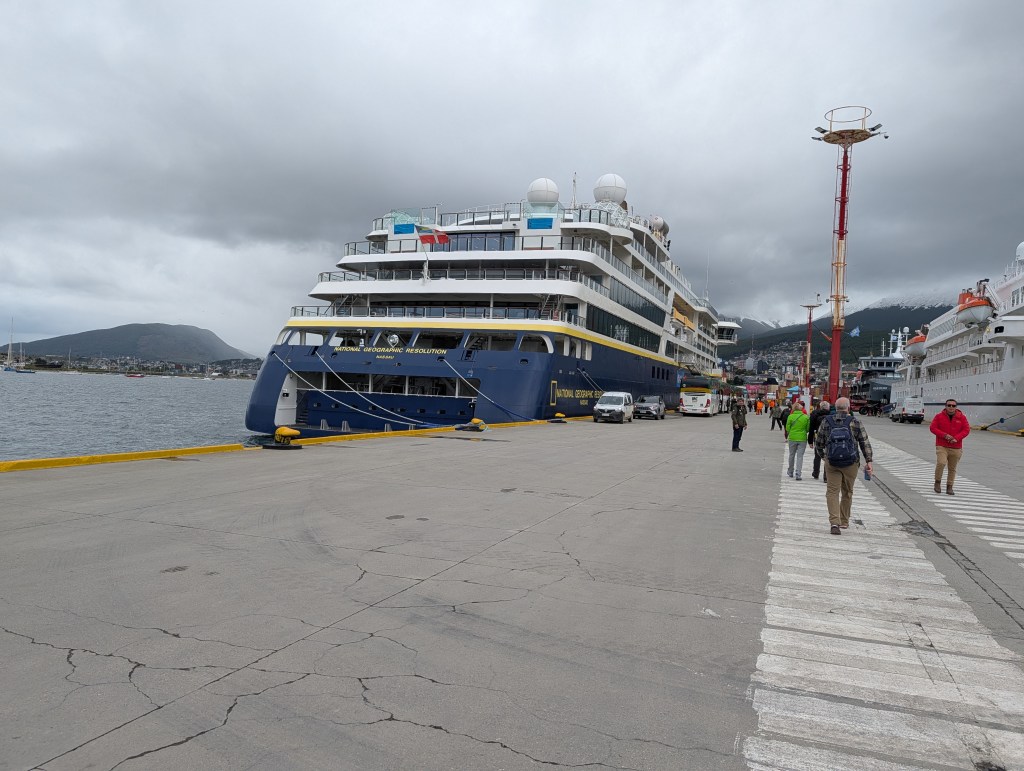
    This trip started on the East side (Sea of Cortez) of Baja, in the city of Loreto. From there, we were bussed over to the Pacific side to San Carlos in Magdalene Bay where we boarded the ship. Once again, as a single, I was in steerage, at the waterline. Not so bad – great cabin, with easy access to the mud room at the stern, where you board the zodiacs. Nice view from my port holes too.

    The first two days were spent chasing whales, cruising around the bay in local fishing boats (pangas), and a visit to a local fishing village. The whale chasing was fun and interesting, but the whales were just not as friendly as I was hoping for. No photos of whales leaning into the boats, and I never got to use my new GoPro to capture underwater shots. Darn. But I did get some pop-up head shots, and it was fun riding along in the bay with the local fishermen. Unlike Humpback Whale breaches, Gray Whale head shots look a lot like a marine buoy. Oh well, maybe next time.

    Panga (small boat), filled with passengers from our trip

    For the remainder of the trip. we followed the coast line around back to the Sea of Cortez, stopping to chase Humpback whales or anything else of interest – that’s the cool thing with National Geographic. The schedule is always flexible depending on the weather and wildlife. 

    One big mistake I made prior to this trip, was my selection of camera gear. I was focused more on underwater photography for the Gray whales and snorkeling. I had been planning on purchasing a new, longer zoom lens later in the summer, but did not think I would need it on this trip. A big mistake. As we continued south along the Baja coast, we saw quite a few active Humpback whales, some with calves, breaching. There were quite a few passengers with 400, 500 and 600MM long lenses, who captured some excellent photos. All I had was a 300MM – not long enough. And as always with whale photography, you never know when something exciting will happen. I was on the wrong side of the ship when a really large whale breached right along side the ship. There were passengers on their balconies, that suddenly had a whale a few feet away..airborne. Amazing. At least I got to see it. 

    And at least I did not have whatever they had for lunch.

    Urp! (not really, they were just looking at fish passing by below)

    The background for the Humpback photo’s would have been great with a longer lens. Live and learn.

    If only I had that new long lens

    Our next stop once we turned the “corner”, and headed into the Sea of Cortez, was a small village which had switched from fishing to eco-tourism – this was a real success story for rebuilding the fish populations in the area. There is also a large sea lion colony there, which has become a major tourist attraction, where you can swim alongside the colony and interact with the sea lions. They are used to people, and seem to enjoy showing off. I was all set for capturing a close up, which I had missed in the Galápagos Islands. We loaded up the Zodiac boats and pulled up to the colony – amazing number of barking sea lions, many of them swimming around the boats. Sort of like pulling up to a colony of Golden Retrievers. I got myself organized, held onto my camera setup, and stepped off the boat..right on top of a sea lion. We were both surprised. We stared at each other for a minute, and before I could get the camera up, it swam away. Yet another lost opportunity. So once again, no close ups. Crap. 

    Passing by Cabo
    Just showing off

    The rest of the trip included some hiking – nothing spectacular – we spent some time with the National Geographic photographer finding things to shoot along a beach hike, and did a nice strenuous hike up a gully for a view across to the Pacific. Along the way, a group of locals were working their way down the trail, with big sacks of mollusks across their shoulders. We walked over to their village afterwards (a nice open air bar), and found out that they do this to get the bait for their lobster and crab traps. Unbelievable amount of work! The trail on the other side is extremely steep. 

    Me….top of the hike. Nice ocean view. Villagers came up that side
    La Paz Fiesta – great dance troup

    And there were some incredible view of the amazing Baja coast – imposing desert and mountain ranges.

    We eventually disembarked where we started out, in Loreto, and had to hang around for most of the day at a nice hotel on the waterfront, until we could go to the airport. This is a very small city, with an equally small airport – there are very few flights in and out. Once again, I made it home very late due to very long lags between flights – this time, I had to wander around LAX for about 5 hours. Overall, a fun trip, but disappointing in terms of photography. I did fall in love with Baja – the landscape, mountainous desert hitting the sea, the culture and people were incredible. I already have a return trip scheduled.

  • In search of Darwin – National Geographic “Expedition” to the Galapagos Islands

    My wife and I had a long list of places to visit in our “golden years” – mine was a bit more on the adventurous side, while her interests were more around culture, food and tennis. But we had a lot of overlap, and the Galápagos Islands were one of those. So, as I started to peruse the many tour catalogs I had received, it was an easy pick for me. We had looked at National Geographic before – Jan was not into cutting costs/comforts, and the NG/Lindblad trips had it all. So, I signed up for a fall trip, leaving plenty of time to start gearing up!

    National Geographic/Lindblad tours are quite a bit different from traditional cruises – their ships are all relatively small, so there are fewer guests, only one dining area, no shows or casinos, no pools or playgrounds for children – just the basics, but these are all extremely well done. The focus is all on exploring the destination, and providing the tools and guidance you need to get the most out of the experience. The ships are packed with zodiac boats for getting you out to shore for hiking, snorkeling gear, kayaks, paddle boards – pretty much everything you need for the adventure. The staff includes National Geographic photographers, naturalists, and locals who know the culture and history of where you are going. They cover all the bases.

    So, off I went to Ecuador (they own the islands) for my first solo trip. I was OK with the travel, since I was used to that from years of consulting, but absolutely petrified about being on a small ship, with 84 perfect strangers. I knew I was going to have to walk up to a table in the dining area and ask “May I join you?” What if they said no? My fears were totally unfounded. Pretty much anyone on a NG trip is there for the same reasons, be it photography, snorkeling, hiking, and for the most part, enjoy making new acquaintences. By the time we boarded the ship on Isla San Cristobal, I had already met 5 or 6 couples, and a few others who were interested in photography. After a day or two on board, I was usually invited to join groups for lunch or dinner rather than having to wander around to find somewhere to sit. 

    The problem with touring the Galapagos Islands is that there are at the very least 11 islands worth visiting, spread out over an extremely large chunk of ocean. You have to cross the equator to visit a few of them. And you can spend more than a day on each of these islands – they really are amazing. This particular trip covered the eastern islands, which included two of the inhabited islands. The largest island, with the active volcanos, is included in a different tour. I’ll catch that the next time I go there.

    I could probably write a few pages about this trip, but that was not my intent for starting this blog, so I’ll just cover a few highlites of the trip:

    If you are familiar with Charles Darwin, and his Origin of Species, you know about the finches, and the variations of the same species found on different islands. Not much has changed other than the extinction of many of the animals due to human presence. Ecuador manages the islands as a national park, so there are very strict rules on tourism, and who gains entries to  the remote islands. This is not a place to party on the beach. Because of these rules and the lack of more recent human activities (whaling, hunting, etc) the animals have no fear of us, and basically ignore you as your group meanders along trails. It is bizarre. On one hike, we were able to gather around a female sea lion feeding her newly born pup…from a foot or two away. Birds nest on the trails, and completely ignore you as you step over or around the nest. Large iguanas just about sit still as you walk right up to them to snap a photo. At one lagoon, an immature flamingo wandered through our group, on the way to the beach.  I was sitting on a rock at one stop, photographing a pelican, when a big sea lion waddled up to me, stopped a few feet away and checked me out, then waddled away. I’ve never quite seen anything like that before. It is a birder’s paradise – there are so many species of birds, and it is so easy to spot and photograph them. Here are a few shots of some of the beasties we saw:

    Yup…they even have flamingos there
    Mother Sea Lion and newborn pup next to trail
    Waddling over to say Hi
    Nap time…
    Sea iguanas, watching us walk by
    Blue Footed Boobie
    Brown Pelican
    Red Footed Boobie babies
    Blue Footed Boobie baby

    The tour also included a stop at the Darwin Center on Isla Santa Cruz – this is one of the locations where they breed the giant tortoises. We also visited a “ranch” where the tortoises are wild, doing there thing. Which is basically lumbering slowly around, eating grass, and then fertilizing on the other end. Rubber boots are a must.

    Racing along in the wild…
    Doing what they do best….eating. No photos of the other end

    We had a few snorkel opportunities on the trip – the water is quite cold there, even with the proximity to the equator, thanks to the Humbolt current passing through from Antarctica. At a couple of locations, we were lucky enough to have visitations by playful juvenile sea lions. They just enjoy showing off. We also saw penguins in the water (and on the shore). 

    Just hanging around…

    And finally, here is the ship, sitting in the middle of an enormous volcanic caldera (flooded obviously)

    Home for a week – Endeavor
    One of many great sunsets

    The trip was fantastic, and I survived being on my own for 10 days. I did learn something else about travel from my wife. First or business class is the only way to fly. Worth every penny. It takes the pain out of flying.

    One sad note from this trip. A few days into the trip, I received a message from my sister-in-law (they had Wifi on the ship) that my brother was in the hospital. I had just spoken with him a day or two before, while I was waiting for my next flight in Miami. Two days later, he passed from stage 4 liver cancer. Ouch. The crew let me use the ships satellite phone to make some calls, and were so helpful the next few days. I decided to keep on with the activities, since my brother was so excited about me being on this trip – he and his wife were master birders, and had been to the Galapagos Islands before. Later that day, I was sitting alone below the bridge, just meditating, when I noticed what looked like the Bat Signal in shadow, moving around on the deck. I looked up to see a squadron of frigate birds, riding the air wave from the bow of the ship (we were moving to the next location)

    I took that as a sign to keep enjoying the trip.