I was planning on at least one more major trip before the end of August, possibly to Iceland (or some other distant land). Unfortunately, I need to be close to home for the next few months for medical issues, so I will be going off on 1, 2 or 3 day trips, all within a reasonable drive radius from home. Much like my recent San Francisco/Alcatraz trip. I live in California, not too far from Nevada, close to the Sierra, the coast, heck, even Oregon is not that far away by car. So instead of looking at National Geographic, Road Scholars or World Wildlife Federation brochures, now I’m looking at California State Park brochures, and just doing Google searches on topics that are of interest to me.
I live in the Sacramento area, a short stroll from the American River, and close to the center of the California Gold Rush from the 1800’s (John Sutter’s fort is in Sacramento). So there’s a gob of historical places of interest all around. The area around where I live was heavily mined for gold by dredging where large barges scoop up material from stream and river beds, run it through a series of sieve to filter out the gold, and then deposited the waste rock and gravel in huge piles. You never need to buy river rock where I live – I just walk around the trails and pick what I need from the big piles along the trails. Digging holes in the yard can be a challenge though. Other areas in the foothills were mined via hydraulic methods, which blasted away the slopes around streams and rivers with high pressure water – it was horribly destructive, causing flooding and impacting water quality as far downstream as San Francisco. And then there was traditional hard-rock mining, which is what this post is all about.
The Empire Mine, in Grass Valley, is a California historical state park, and a real gem for anyone interested in the mining history of the state. It offers a unique view of both the complexities of hard-rock gold mining, and of the families that developed and profited from the mines in this area. The Empire Mine started out as individual claims worked by individuals with pick-axes and shovels, until a wealthy merchant from San Francisco decided to get into mining and bought the property. The tour guide gave a lengthy and interesting talk about the family, how they developed the mine into the gold standard (pun intended) for large mine operations, and a lot of interesting side stories of the other ventures they were involved in. I won’t repeat any of that (Google it if you want).
OK, enough about history. The park is nicely split up, once you enter the visitor center, into the mine workings, and the owner’s mini-mansion and grounds. The visitor center is excellent, small but packed with mine history. What is really unique is the “Secret Room” – starting in the 1930’s, the mine engineers maintained a wire model of the entire mine and maintained that until operations ended. Once you figure out the structure of the model (a recording helps you along), you realize how incredibly enormous this mine was. Each wire represents either a shaft or a horizontal drift, and the stepped ramps are the angled shafts which were used for entry and pulling ore out. There are miles and miles of drifts and shafts. Apparently, almost everywhere you stand in that area has mine shafts underneath to a depth of over 8000’. That’s a really big mine.
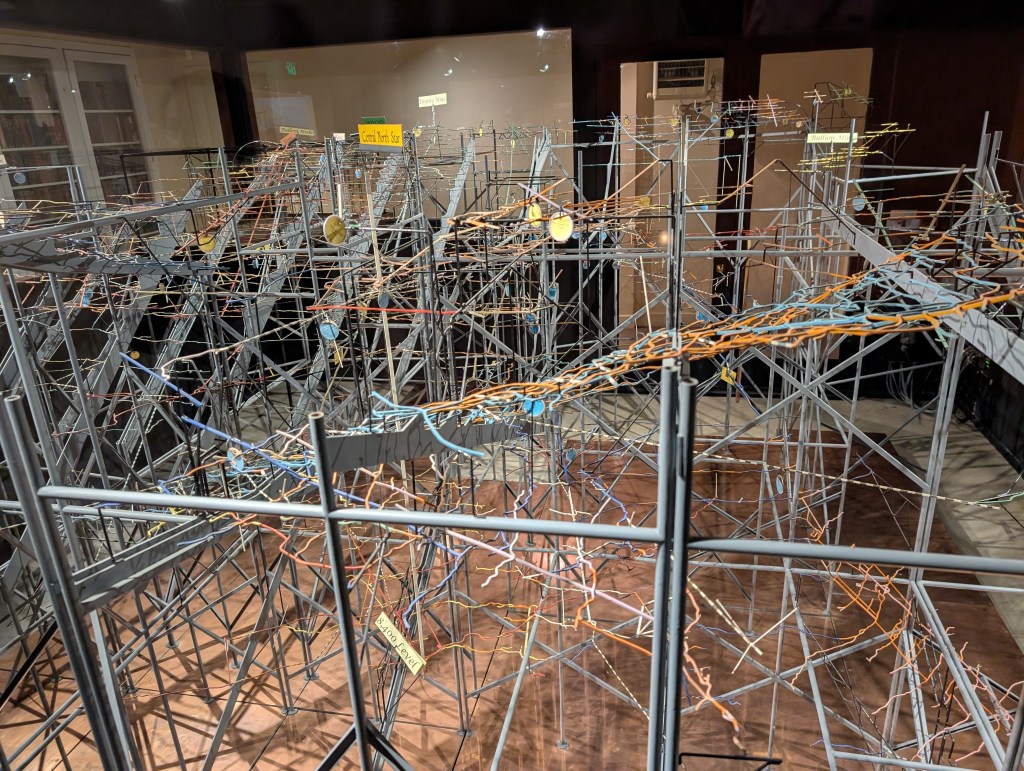
This mine was the largest in the area and in California, although one did go deeper. I won’t bore you with all the details of the mine – you can Google it if you want.
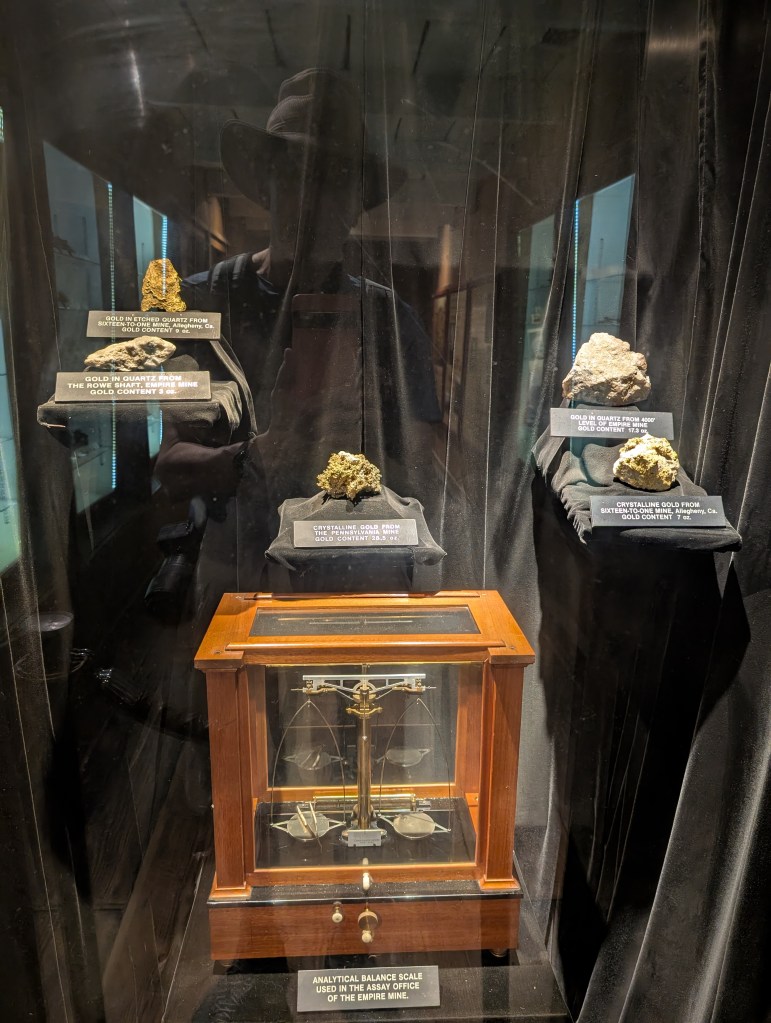
The center also had a bunch of old photo’s, and videos of the mine operation. All interesting. And, a nice geology display of minerals and gold. Interesting to me at least.
The mine was operational until the price of gold was too low for the mine to be profitable. Once it closed, it was sold off to the state and once they shut off the pumps, the entire mine flooded – most of it is below the water table so Mother Nature takes over. Maybe they should open it for mine diving. Frightening.
So what can you see in the park? It’s basically two separate parks. One tour takes you through the grounds and the owner’s “cottage”. The original owner had this thing for British gardens, so the grounds look like something off of Downton Abbey. Worth wandering around if you like old mansions. (I don’t…been there, done that in England).
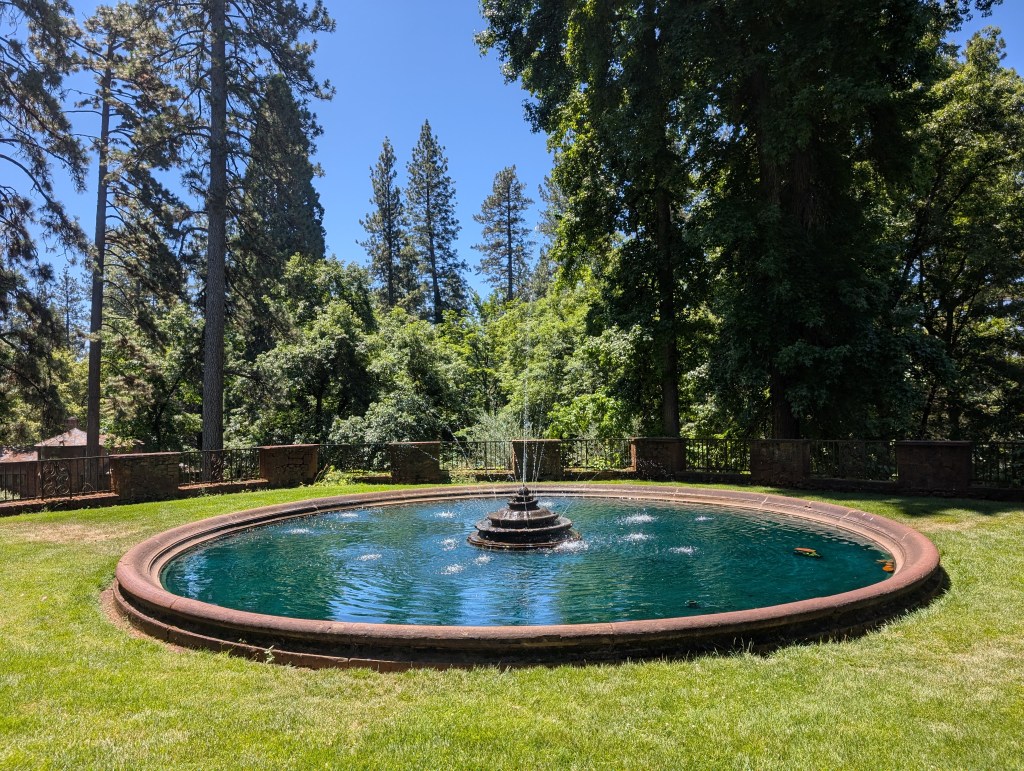
It does have some nice gardens, and a pretty reflecting pool. This is a mini-version of Filoli Gardens in Woodside, which the owners’ family built. One other interesting fact from this part of the tour – there is another small building associated with this family. The mansion currently owned by the Culinary Institute of America in St. Helena was also built by a member of this family. Unlimited wealth opens up a lot of doors. And installs quite few as well.

The other half of the park includes all the remaining buildings – workshops and offices, examples of equipment, and the ruins of the main processing building where the ore was crushed and the gold extracted. The process used large quantities of mercury, and cyanide. I would not recommend chewing on dirt or rocks in the park.

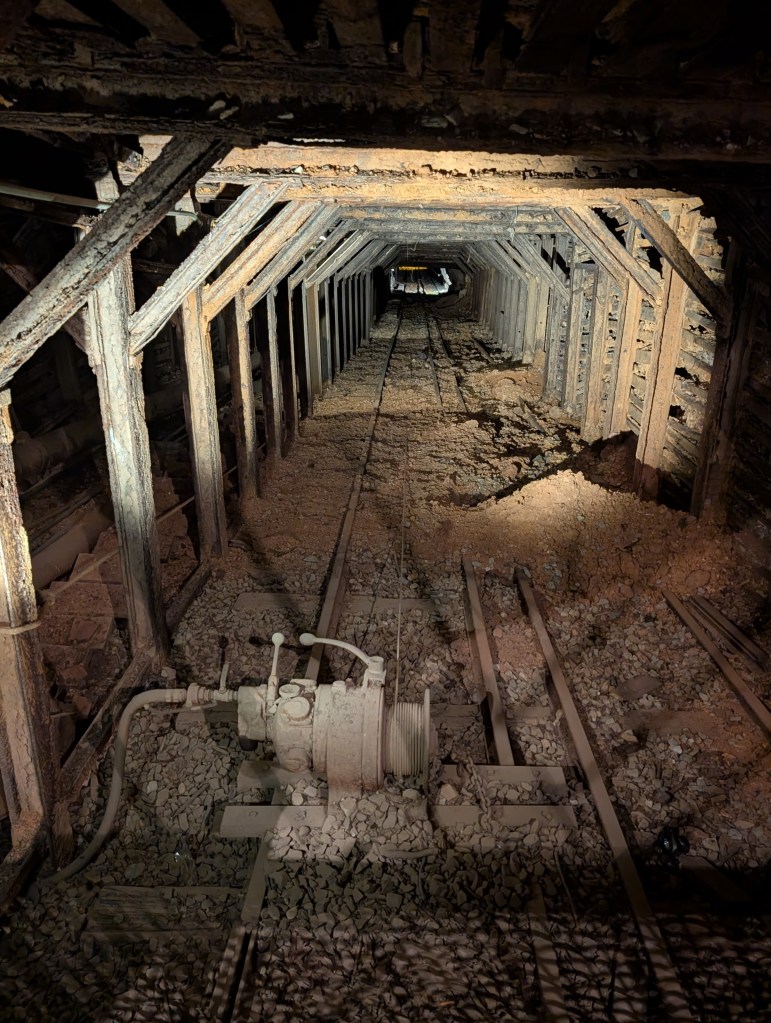
While the flooded mine is closed, you can enter a short distance into the main shaft, and look down the 45 degree rail line that the miners rode into the mine. You sit on the big wooden sled, and the guide run’s a little routine that turns off the lights and vibrates the sled, to simulate what the miners experienced as the sled ran down the shaft to the working drifts. Fun for the kids.
I spent a couple of hours in the park, wandering through the visitors center and mine yard, going with the tour through the owners house, and then checking out the gardens. I’ve been to a lot of mines before in my geology days, so I did not have much interest in seeing any more of the mine ruins and display. (I once got a tour of a potash mine in New Mexico, and got to ride around underground in one of the tractors, to visit the drilling sites). I beat a hasty retreat back to the car. It was getting uncomfortably warm anyway.
There are a couple of other mining sites in the area which offer tours – I’ll pass on those. These are all run by private operators, and are more ‘touristy’ oriented with gold panning for the kids. I’ll pass on those. There are tourist mines in other parts of the state and in other states as well, that take you into the mine. Not worth the drive for me. The only other site I’d like to see is another state historic park, which was a center for hydraulic mining in the 1800’s. It’s close to home, and sounds interesting.
My next local trip will be something I have not done since graduate school. Spelunking. Well, initially just a tour of a cavern. If I enjoy that, they offer introductory cave exploration. That might be interesting….worthy of another post.
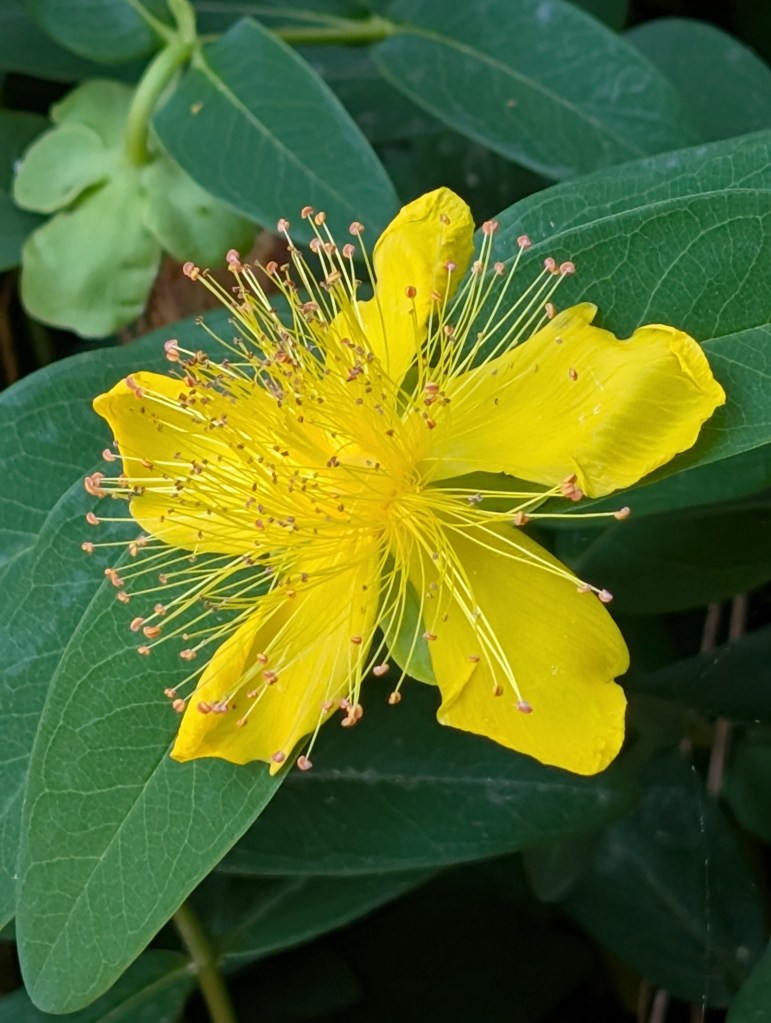
A nice flower from the English gardens
More information on the Empire Mine can be found on the CA State Park Website: https://www.parks.ca.gov/?page_id=499
 The Traveling Widower