Tag: adventure

  • A dark and damp experience – Caving Part 1

    Greetings, welcome to our camp, we all know why you’re here

    Back in the olden days (graduate school…that’s a long time ago), one of the professors in the geology department was 1)a Boy Scout troop leader,  2) an experienced spelunker, 3)Liked to get away from his wife on weekends. Put these all together, and I wound up with many opportunities to go on spelunking trips in Indiana and Illinois. This was serious caving – wet caves, high water entries, lots of mud, no lighting, rappelling down cliffs, mandatory hard hats. And a lot more risk than visiting tourist caverns. I don’t remember seeing too many exciting things from any of the caves we explored – I only remember lots of mud and water, slimy crawls along really small holes, fighting his 6 year old son trying to crawl by me, and the smell from the carbide lamps we used to light up the darkness. Fun stuff when you are 21 and single.  This same professor even managed to get us access to some really huge lava tubes in the Craters of the Moon National Park in Idaho. A very sharp and painful place to crawl. Where am I going with this?

    I vaguely remember somewhere along the way, visiting one other touring cave, where there are guides, dry paths, electric lighting, and large magnificent rooms. A much more civilized way of caving, and my wife may have been with me. So, when I started looking for things to do in my forced detention in Northern California this summer, I discovered that there were a few caverns in the area which had guided tours. One was relatively close to home in Amador County, the other a longer drive in Calaveras County, and another up by Redding. So, I chose the one in the middle for my first caving adventure. 

    The California Cavern is located just outside of the cute town of San Andreas, about 90 miles from where I live. At one point in the past, the cavern was in an even smaller town, Cave City, populated by local miners (some people lived in the cave). It’s a pretty drive from where I live, traveling down along the foothills of the Sierra.  Warning, here comes some sad stuff – I have a lot of good, and some not so good, memories on this drive since my wife and I used to spend a lot of time in that area. We traveled along there a few weeks before she passed – it was spring, and everything was bright green from the rains, and Jan wanted to see it. Like I said, a sad memory. Enough of that. 

    The instructions for the tour in their website were specific about what you can bring along inside the cavern – no backpacks, hiking sticks, food, water bottles – pretty much nothing other than the clothes on your body. The cave formations are very delicate, so they don’t want you grabbing anything or dropping anything in the cave. So, I decided to bring one camera with a small telephoto lens, my phone, and have the GoPro on a chest harness. I neglected to read the instructions about no videos allowed. When I finally got there, I had a chat with the tour guide, who said I could shoot video, but only small sections of the tour. I figured at that point it would be better to just leave the GoPro in the car. I could always use the phone.

    Aside from myself, there was only a family with four young children on the tour. The tour guide was a very tall young man, who has been working at the cave for a few years – he is an experienced spelunker, and leads the tours which go through the non-civilized portions of the cave. The cave is quite large, but fully explored and recently mapped with LIDAR.

    So off we went down a short trail to the entrance – a very small opening, with a cool breeze blowing out. The temperature in the cave is a constant 53 degrees, and extremely humid. It is a wet cave – there is always water dripping, and portions of it flood during the rainy season. There is also a lake, which is included in one of the other more serious tours. For us, we were limited to a small section of the cavern which has lighting (dim), railings where needed, and a somewhat paved path. That’s about all I was looking for on this trip.

    Main entrance – very dim and narrow as soon as you step in

    So right from the gitgo, I realized a couple of things – first, I should have put my photogray glasses in my pocket for a while, before entering the cave. There are lights in passages and rooms, but the path itself is dimly lit, and I was pretty much blind until my glasses transitioned back to clear. Sun glasses are not a plus when walking in the dark. Fortunately, that was just for a minute or two. Second, I should have worn my hiking shoes – everything is damp in the cave, including the ground, which was quite slippery. Finally, carrying a heavy, very expensive camera was a dumb idea – it’s hard to get through narrow passages and long, low sections with the camera hanging from my neck. I had to protect the camera when I needed to balance myself to keep from falling in some sections. Dumb.

    The tour lasted about an hour in the cave, as we wandered through very narrow, slippery passageways to larger areas where the guide pointed out the unique features on the walls and roofs. There was a little bit of climbing, with steps cut into the floor, and metal railings along the way. We were warned about grabbing on to the walls but sometimes, it was impossible to avoid doing that (for me at least). Everything was damp and dripping – it was pretty close to being a real spelunking experience (except for the trails and railings and lights). The guide was great – he described the features in each of the larger areas we stopped in, and threw in some of the history and interesting stories about the cave. 

    Typical section of path – dim lighting, nice but wet railings
    Our guide, describing the formation..notice all the thin straws.

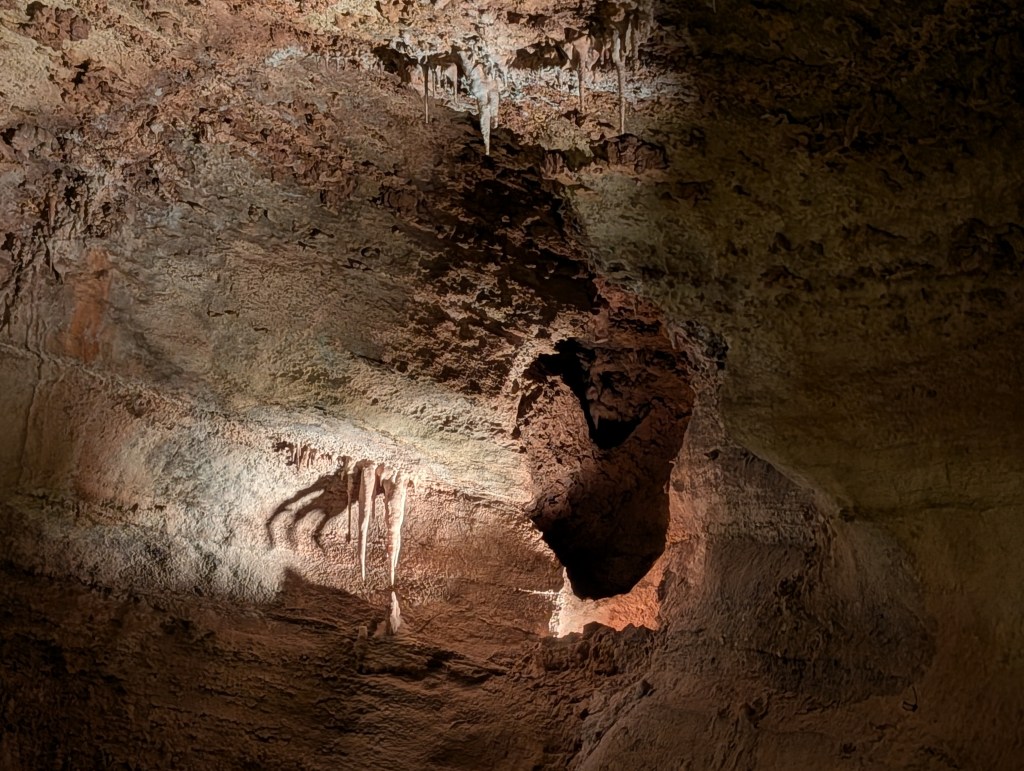
    There were too many interesting mineral deposits  and features to describe – different shaped stalactites, stalagmites, mineral flows, hollow straws – fascinating and beautiful stuff. Better to show a sampling of photos (I’ll post an album link on the main page):

    Hollow tubes, with strange shaped deposits on them
    Baby budha (use your imagination)
    Another section of the path
    Sharp cieling
    These fluoresce in the dark after shining light on them
    More strange flows

    Towards the end of the tour, our guide told us to put our phones away and cover our watches, then turned out the lights to give us an experience I can live without – total darkness. I’ve done this before so I knew what to expect and leaned against a solid wall. It is a frightening experience. He said you might think you can see your hand in front of your face, but it is just your imagination. After an hour, you begin to hallucinate. He lit a candle to show what it was like for early explorers. No thanks. I don’t like to even think of what it would be like to be stuck in a cave without a light source.

    Very dark, no thank you.


    After that,  we made our way out through another narrow passage to exit through a different cave opening, back into daylight. I looked down at my legs, which had streaks of mud. And then looked at my camera, which also had streaks of mud. As did my phone. And my shorts. And my shirt. And my brand new walking shoes were covered in mud. This was almost like real caving. It was a blast though – I thoroughly enjoyed the experience. I’ll definitely do the other two cavern tours in the next few weeks. And I’ll think about the more advanced tour at this one. That’s 3.5 hours crawling around with headlamps, and includes rafting across the lake. In the dark. Hmmm. Maybe not.

    And about that skeleton photo – I think that’s there to scare the kids. There are spiders and some other creepy crawlies in the cave. And a rubber bat. No cave bears.

    If you are interested in visiting this or the Black Chasm caverns, here’s the link for both of them: https://cavetouring.com/

  • Escape to (and from) Alcatraz

    My big day did not start too well – I tweaked my back somehow walking around, and it hurt pretty bad in the morning. A couple of Ibprofin helped, and I Uber’d over to the Alcatraz Ferry stop (Pier 33) rather than walking again. Good move. And, it was a crummy morning – cold, damp and a bit foggy. It’s summer in the bay, so this is pretty much the norm. The company managing the ferry does a really great job of handling the crowds (it was crowded), managing the groups getting on and off the ferry boats. I was there early, but they let me board a half hour before my allotted time. They have three or four different boats, all with multiple decks and snack bars. The ride was short – maybe 15 minutes.  Once you get to the island, a park ranger gives a welcome spiel, and then you are  pretty much on your own, and that worked fine for me. There is just sooo much to see. You do get a map ($1, optional), and it’s kind of hard to get lost on an island.

    Waiting for a ferry
    Boarding the ferry – lots of people, but well organized.
    Cold, crummy day so far
    Looking back to city…typical summer day

    The next image, as you get close to the island, is a great view of what to expect when you get there. The very top of the hill (The Rock) is the cell block, which includes the lighthouse and warden’s house at one end. So much to wander through. It’s a steep path to the top (and an even steeper stair case on one side). The boat docks by the big building on the shore – an old fort/barracks, and the main entrance. At the other end, below the water tank, is the power plant and beyond that are even more buildings. There are paths circling the entire island as well. Plan to spend some time there, and wear good walking shoes!

    I had spent a little bit of time checking out the National Park web site for Alcatraz, and knew a little bit about it’s history, but it is still amazing when you set foot on the island, and see all the old buildings, many just ruins. The first building you see when you get off the boat was an old fort turned into barracks (the big white building in the photo above), from the 1860’s. Across from that are the ruins of the officers club, now a hangout for Sea Gulls….which are all over the island. More on that in a bit.

    I was planning to be on the island until there was nothing left to see, so I was in no particular rush to get to the main attraction, the cell block. So after spending some time photographing the ruins of the officers club and checking out an old cannon (a strange obsession of mine), I opted to first visit the Alcatraz gardens since they close off early. What a surprise – the gardens go back a long time, first started by the army – not a huge area, but some really beautiful flowers. Seems so out of place there, but there are gardens all along the island perimeter. 

    Flowers everywhere….it’s a nice climate for growing things that like cool, damp weather.

    And one more…

    After that, I worked my way up the hill (very steep, but they do have a shuttle from the dock to the top), aiming for the audio tour of the huge cell block. Lots of signs pointing the way with gulls to provide encouragement.

    A side note here…..the island is a nesting site for a number of birds, mostly gulls and comorents so there are a lot of interesting bird shots in this post. Like this one.

    If you’ve never been to Alcatraz, it is an amazing place, worth adding to your list of parks to visit. The free audio tour is excellent – you get headphones and a small recorder, and it leads you through the tour, with directions, descriptions of what you are seeing, and recordings from former prison guards and prisoners. You sort of forget all the othe people wandering around, and just focus on the narrative. This tour covers most of what you would want to see in the main building – the cell blocks, dining hall, solitary confinement, library, the cells where some of the notorious criminals slept, and where the major escape attempts occurred. All described in detail on the audio. Once you are finished (and might need a break), you turn in the equipment, and you are on your own to wander the island (ending up in the gift shop of course). And there is so much more to see. And yes, there are bathrooms that are not in a cell.

    Typical cell – en suite bathroom
    Fully furnished cell – they even had a built-in radio outlet (just two stations
    One of the main blocks (Broadway I think). They all look the same

    Oddly enough, I did not take too many photographs in this building. All the cells kind of looked the same, and the interesting part was the story you heard on the recording about each stop. By the way, the shot above was not a miracle, having it free from the crowds. I used Google Magic Eraser. Poof! People gone (except for shadows)

    I spent about four hours total on the island before I ran out of gas and took the ferry back. It was extremely windy, with all kinds of steep paths and stairways to climb, but all worth it. The views are incredible, and if you can stand the smell, there are some huge bird nesting areas to view.

    In some places, the gulls were nesting right along the path, and you could see little, grey spotted chicks around the nests. Cute. 

    After circling the island, and checking out the power plant and other buildings on the end of the island, I meandered slowly back down to the docks. I had enough. I hopped the next ferry back, found a nice comforable chair by the window, and enjoyed some quiet time, doing absolutely nothing. After disembarking (I love that word), I checked out some of the displays they have in the waiting area for the ferry – some large cannons (huge) from the old army installation on the island (Civil War era), and a big model of the island. I used the people-poofer on this photo as well.

    I was initially pretty much convinced that I would just head back to the hotel on the way back, but then thought about the WWII Liberty Ship, the SS Jeremiah O’Brien, at the next pier. I always wanted to see that, so my day was not quite done.

    I’ve always been something of a history buff when it comes to the Civil War and WWII. Not sure why. I had this thing for fortifications since my early childhood, when we visited Revolutionary War forts in upstate New York. I dragged my wife to a few of these piles of bricks later on – she suffered quietly through this obsession of mine. Growing up in NYC, my father used to take us to Manhattan for the annual Navy fleet weeks, so I’ve scrambled around all kinds of warships as a kid. There are not too many of the old ones left, so I try to visit any that are within striking distance, wherever I have lived. Jan and I did a tour of the USS Hornet a few years ago in the Alameda, and I think she enjoyed that one. Maybe because we visited the Hanger One distillery afterwards. At any rate, I’ve always wanted to tour the WWII liberty ship that’s tied up at Pier 37 in San Francisco and since I was a short walk away, I decided this was the time and place.

    Stern view of the O’Brien – that’s a 3 inch gun barrel sticking out

    I was really tired, and even my good knee was aching. So the first thing I see is a steep gang-plank to get on board. Wonderful.

    Ugh. The only way onboard…sorry knees

    This is a self-guided tour. You can go just about anywhere on the ship, unless there is signage that says don’t go there. The entire ship is a museum – all the cabins have original gear, and each has a description as who slept there, or what it was used for. You can visit the bridge which is functional, climb up to play with the guns, pretty much go anywhere you want within reason.

    Galley – still functional
    Functional bridge

    Funny thing about the bridge. You always see in films, the captain ordering ‘full speed ahead’, and one of the crew members sets the speed on that big contraption with the pointer. I never quite understood what that does. Now I know – actually nothing. There are chains connected to a similar device in the engine room, and it just sets the pointer on that one. The chief engineer sees that, and yells at the crew to turn the dials, valves, light boiler fires and all the other stuff that makes the ship move. Who knew?

    20MM Cannon
    Looking forward from the bridge

    Absolutely the best exhibit of all, is not an exhibit – you can visit a working engine room. At your own risk – a big sign says so at the first ladder going down, and there are lots of signs saying “HOT – Do Not Touch”. This is a functional ship – everything works, and the ship still cruises around the bay under it’s own power. There are a series of REALLY steep ladders that descend to the lowest level where you can see the boilers and pistons that drive the ship’s single propeller. The engineer who maintains and runs the engine room was there, and enjoys answering just about any dumb question you have. I almost understood some of what he was saying about steam condensers, and somehow got into the equation for determining the amount of pressure in each of the 3 different engine cylinders…something which inclues pi. He lost me after a while. It was like talking to a software engineer at Google.

    Looking down – lots of pipes. Steam driven engines are complicated
    The “crankcase” that drives the propellor shaft
    Boilers on either side, and a lot of guages and dials. Not like a Tesla

    Another of my favorite parts of this tour, was the museum they put together in one of the forward holds (this is a freighter). They have a lot of photographs along the walls, giving the history of the ship and liberty ships in general, plus an interesting film on the history of the ship. There are only two remaining, of the thousands built for the war – hundreds of them were sunk by submarines and aircraft bombs. It was a dangerous job working on these ships. The O’Brien served in both the Atlantic and Pacific theaters of WWII, and carried equipment to support the D-Day landings. Quite a story. Worth watching the whole film (getting into the hold was yet another steep ladder).

    After a while, my legs were telling me enough climbing up and down ladders. I even opted out of climbing up to play with the big gun (3”) on the bow. It was time to head back to the hotel. I had planned to wander around, maybe hike up to the Coit Tower, but that was no longer an option. It was Uber time. Followed closely by martini time. When I first made the reservations, I had thought about just staying one night, driving home after I was done at Alcatraz. I was so glad I decided to stay the additional night. No way I could have driven home.

    Well deserved, followed by a nice grilled salmon dinner

    So, that was the end of my mini-trip. Check off two entries from my bucket list. A good trip. Except…and here’s the widower part of this blog. It’s really hard going places by yourself when you are so used to being a pair, and then coming home to an empty house. It gets to you after a while. But, I guess you get used to it over time. Or maybe not. Time will tell but I’m not real optimistic of late.

    This may be the last post for a while. I have two full months to kill before my Alaska trip. I’ve got to figure out where to go in-between. I get really bored staying at home. I might go chase whales again, or head up to places I have not been to. Lots of options in California.

    And for those of you who subscribed, I’m sorry if you were surprised to get an e-mail with this post. That’s what you get with subscriptions. You can unsubscribe if you want – check the bottom of the post.

    More information on the liberty ship and Alcatraz can be found on their respective Websites:
    https://ssjeremiahobrien.org/?v=0b3b97fa6688
    https://www.nps.gov/alca/index.htm