Tag: sony-cameras

  • I Need More Toys

    This post is about photography technology and my latest obsession with acquiring new toys for my hobby. So, you can ignore this if you want. Just a heads up.

    The last time I bored my faithful viewers with a post about photo equipment, I may have said that I was through making major purchases after buying the Sony 7 IV. Well, it turns out I was just kidding.

    I had figured that I would be relying on the new Sony A7 IV as my primary camera, and I could bring the older A7R II along if I wanted to have a backup on longer trips. That worked fine for singular focused (more unintentional puns) trips, like whale watching or hummingbirds, where all I needed was the new long lens. The Alaska trip was more of a problem. Most days there was a mix of wildlife and landscape photo ops, so I had to either change lenses on the fly, or rely on my phone for the landscape shots. Zodiac photography made things worse – trying to change lenses in a crowded, small, wet boat introduced a high risk factor of dropping the camera either in the wet boat bottom, or worse, the very wet ocean. In Antarctica, it will be a lot of fun trying to change lenses in the cold weather either in the boats or on the shore…standing on ice and snow. With penguins pecking at my boots.  And if you own a mirrorless digital camera, you have probably already experienced the joy of trying to clean a dirty sensor. 

    For all of my upcoming trips I will have that same mix of landscape/close-up vs. longer distance wildlife photography, and was considering using my very old Sony 7R II for landscape (shorter lens), and the new A7 IV with the long telephoto for wildlife. That would work of course, but now I’d have to lug two different sets of batteries and chargers along. Plus, and now for the real reason, this gave me the opportunity to trade in the old camera (10 years) for a new one. Camera shopping!!!! Off to Mike’s Camera!

    Actually, I did a lot of research first. If I was going to make a major investment in another camera body, I wanted to make sure it was the right one. I had been considering a different line of cameras which use a different, smaller sensor technology than the A7 line, the APS-C  versus full-frame. The Sony cameras are a bit smaller, lighter and a bit less expensive than the full-frame line like the A7 IV. They also have a completely different set of lenses that are designed for the smaller sensor, although the full-frame lenses can be used as well. The problem, for me at least, with the APS-C cameras is the cropping factor – the smaller sensor limits the scope/breath of the image, so you are effectively increasing the length of the lens by 1.5X. That’s great if you want more of a telephoto effect, which is not what I’m looking for with landscape photography. So for example, a 24-70mm lens loses the wide angle, since the crop factor makes this a 36-95mm lens. 

    When I got to Mike’s, I was able to try this out with a few of the smaller sensor cameras. I liked the smaller body size, but the cropping did not work for me. What I really wanted was the top-end full-frame camera, the A7R V. And as it turns out, Sony was having an incredible sale on this camera. And with the trade-in for my old camera, it was less than the APS-C bodies I was looking at. And I would not need to buy new lenses either.  Simple decision – convincing myself took about 5 seconds. Now all I have to do is figure out how to use it before I leave for Antarctica. Plenty of time for that – I’m sure I can fit that into my incredibly busy schedule of doing nothing. I’m sure I’ll be able to talk myself into spending some time playing with the new camera.

    Speaking of lenses, now that I have a long telephoto (500mm), I would really like to get to a point where I only need to carry two lenses – the big zoom for wildlife, and an all-purpose zoom for everything else, something like a 20-150mm. This would give me coverage for just about every situation, with just the two camera bodies. Currently, I have a 24-105mm, and a 17-24mm wide angle. I do not really shoot too much at the lower wide angle range, so if I had a 24-200mm for example, I’d just have to lug two lenses along on trips. Well, Mike’s Camera is having a sale in November, with that exact lens. So I may not be done with my toy obsession just yet.

    Two last comments on photo equipment (if you are still awake reading this…zzzzzz). First – I did mention the use of my phone for landscape photography. The new Pixel 10 has an excellent camera, and I’m finding that in some cases, I’d rather just use the phone instead of the heavy digital camera. Cave tours are a good example – it’s difficult enough just winding your way through tight and/or low passages. It is hard maintaining your balance and keep the camera from banging against rocks at the same time. The same goes for kayaking – I have a waterproof case for the phone (and the GoPro too), so I do not have to worry about trying to keep the expensive Sony out of the water. And then there are crazy hikes like the Manitou Incline. The phone was all I could handle. I did not see anyone with anything other than phones or GoPro’s on that little adventure.

    The second and thankfully last point, is why am I taking photo’s with the big, hi-tech cameras at all. I’m finding of late, that rather than using the blog to describe the images I’m creating with the high-end camera’s, the images are secondary to writing the stories of my travels. I’m using more of the jpeg images from my phone than the higher quality raw photos I take with the digital cameras. But I still want to continue submitting photos to contests, and go on tours focused on wildlife photography, like the Kodiak bear trip or an African safari. If I ever get to the point where all I’m doing are cruises, I may have to rethink my priorities when it comes to photography. Hopefully it will be a long time until I have to make that decision. Besides, the phone technology will probably make full frame digital cameras obsolete by then. 
  • My other hobby – Photography

    Now that I’ve launched this blog, and have actual real viewers and subscribers (amazing), I find myself thinking about new topics to write about during my “in between trip time”, and I came up with one that covers one of the main themes for doing this blog  – photography. Nothing too technical, just how I got into it, and my current kit.

    I’ve always been interested in photography, even as a kid. My parents foolishly let me use their Brownie Instamatic once in a while until they noticed that I would shoot an entire role of film on the same subject…like a statue at the United Nations building. That ended my initial childhood experience. In college, I had a friend who was a very talented photographer, though a little on the strange side when it came to what he photographed and the prints he made in the darkroom. I learned a little bit about SLR cameras and darkroom techniques, but not enough to buy my own camera.

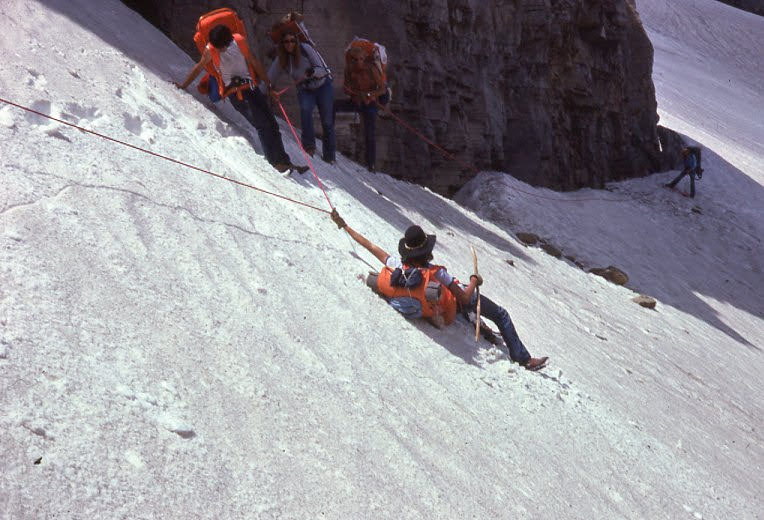
    Fast forward to graduate school i I had another friend who ran the photo lab for the geology department, and once again had the opportunity to learn and maybe try it out on my own. Too bad I didn’t – there were so many opportunities in geology field trips and field camps for photography…like climbing the Grand Teton. One of the students had a camera, and got a classic shot of me, holding on for dear life to a rope to keep from sliding down the Middle Teton Glacier. He was supposed to be holding on to the rope. I think he was hoping to get a sequence of me sliding to my doom. I survived.

    How not to cross a glacier…that’s me It was a very long way down

    Finally, after all these missed opportunities, I had access to a real SLR, and also a Nikon underwater camera. They were not mine though….my soon to be wife owned them, and let me use them. I brought the Nikon along on the summer field camp I was a Teaching Assistant on, and shot a few roles of slides. It was a start.

    Over the years, my wife and I both dabbled in photography. After a rock climbing accident, I began to take it more seriously, at my wife’s urging, in order to keep me off the rocks – I built my own darkroom, joined clubs, went off on wildlife photography trips, and of course, bought a lot of gear, replacing my fixation with rock climbing toys. Those were the days before digital photography and before phones became cameras. I really enjoyed making prints – I still have a few framed ones on the walls of my current abode 

    Once digital photography appeared, and phone photography became common,  we both invested in new technology, each buying new kits based on Nikon. I eventually bought a 500MM telephoto for wildlife photography, which was my focus (no pun intended) for many years. My wife was always more interested in capturing interesting scenes in parks and cities, and sometimes just of people. When Sony started producing high-end digital cameras, we both traded our Nikon gear for Sony, and have stayed with their cameras going forward. 

    So what am I shooting with now? My wife of course had the higher end camera – a Sony A7RII, which has a 44MP sensor, the largest at the time (2016). You can enlarge those photos to wall size. I had an even older model, the A7II, with a 24MP sensor. A good workhorse of a camera. Both were now way behind current technology – so much has changed, including AI features built into the chip. We had a good range of lenses, which we shared – 50-300, 28-105, and a few other lenses, all Sony. When Jan passed, I inherited her A7RII, which became my primary camera body. Most of the pictures I’ve posted in the blog to-date were shot with this camera, except for the last trip. I had been itching to buy a new, longer lens, but being frugal (or cheap) I was holding off on the investment, even after missing lots of good photo opportunities on the Baja trip. That was until the current administration’s Independence Day came along – the potential for a 39% tariff on Japanese products, and a major increase in price made me pull the trigger on buying the new lens, a 100-500MM Tamron telephoto. Very heavy, but manageable. And then after the whale watch trip, I decided to just go ahead and buy a new camera body with superior focusing, the Sony A7IV. The shots it takes were remarkable in clarity…no more wasted slightly out-of-focus shots, and the shutter bursts are 10 frames per second is great for fast moving subjects, like hummingbirds and whales. I used this camera exclusively on my last trip to the Utah parks.

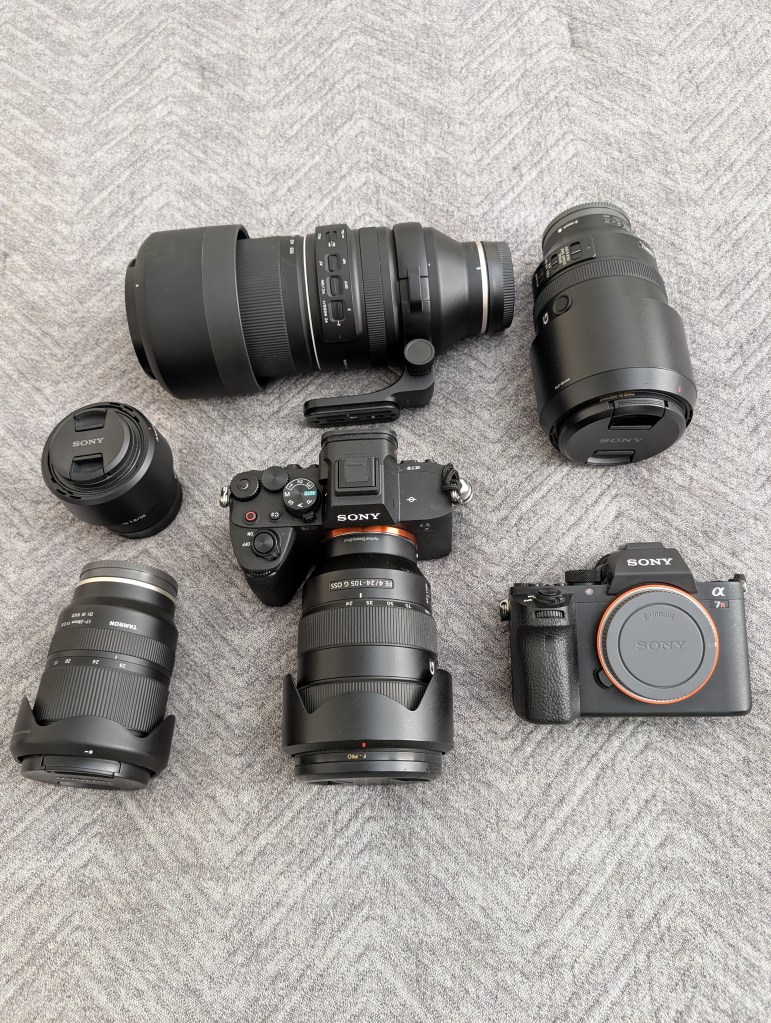
    All my toys

    So unless I win a lottery, this will have to hold me for a while in terms of cameras and lenses. Here’s a picture of the whole kit and kaboodle – I take all of this on some of the trips (Alaska, Galapagos, but have to cut back on other trips based on luggage size and weight restrictions. That’s a lot of weight for carry-on, especially on smaller planes.

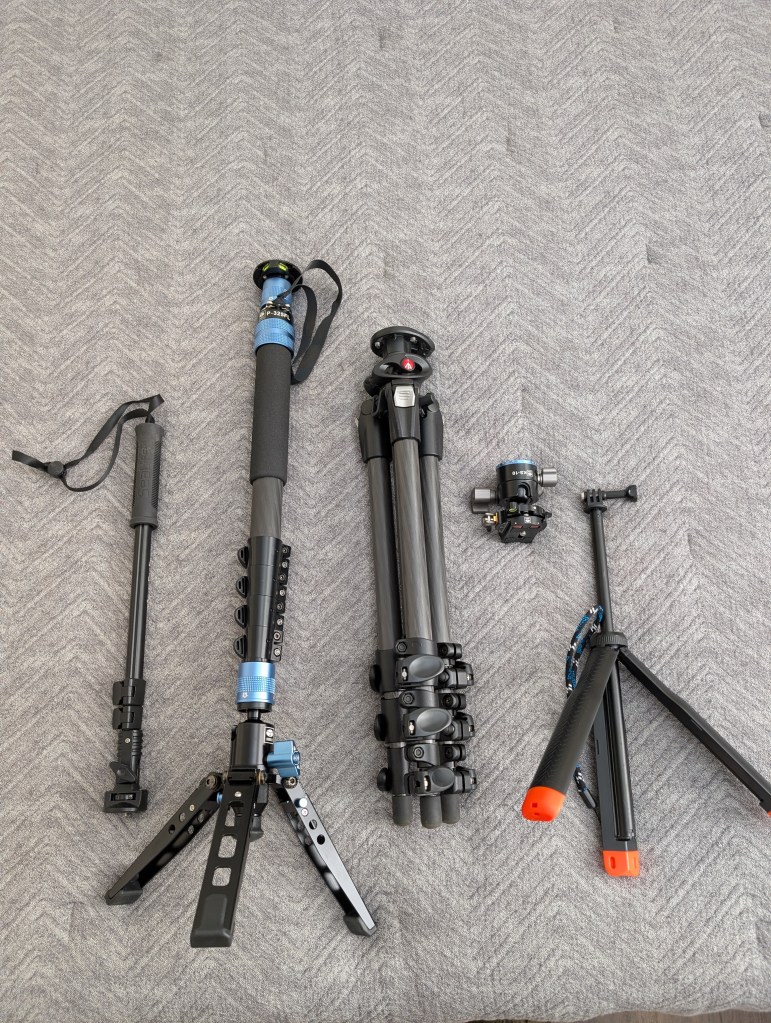
    But that’s not all I have to lug around. Some trips/subjects require more stability, like hummingbirds, shore birds, sea otters….and that requires lugging a tripod or monopod along. The tripod only works for car trips – hard to carry that on airplanes, and impossible to use in small boats like the Zodiacs that National Geographic uses. So that’s where the monopod comes in. That was another Independence Day purchase. It’s hard to find any high-end camera gear made in the USA.

    Tripod, monopod (with feet), GoPro extension rod, extension rod with feet

    But wait, there is more! I also have underwater / action cameras. I have a GoPro 13, and a Sealife underwater camera with a frame, a big U/W light, and a large wide angle lens. Unfortunately I no longer need the Sealife since I’m not allowed to Scuba Dive anymore – when your cardiologist says NO, you listen). The GoPro is fine for snorkeling, and is easy to pack.

    What is not in either picture are the batteries and chargers needed for all the cameras. Or SSD drives I bring along to backup the photos. There is just a pile of stuff that you need to pack and haul around for photography. Not complaining…just wishing I had a llama sometimes. I do have some nice photo backpacks…another post will cover that.

    And finally (almost), there is one more camera I use frequently on these trips. It’s a Pixel 8 phone. Before going on the Galapagos Island trip, I watched a video on photography by one of the top National Geographic photographers, giving advice on what to bring on these trips. He said sometimes the best camera is the one that is frequently in your hand. Your phone. He has published many photos from his iPhone. The Geographic photographers on both trips gave lecture on phone photography as well.

    So do you really need all this “stuff”? Depends on how serious you are about photography, and what you intend to do with them. And how much you want to carry this heavy, awkward gear around on trips. My wife gave up on ‘real’ cameras a long time ago, and only used her iPhone. We were going to buy an underwater housing for it, so she could use it diving or snorkeling. For me, it’s my hobby, so I’ll continue to use both. Plus, I like shopping in camera stores and buying new toys. If REI had a camera department, I’d never shop anywhere else other than Whole Foods for groceries. My life would be so much easier.

    So this post has been all about the gear. How do you pack all this stuff for a trip? I’ll get to that in another post.