Category: Photography techniques

  • I Need More Toys

    This post is about photography technology and my latest obsession with acquiring new toys for my hobby. So, you can ignore this if you want. Just a heads up.

    The last time I bored my faithful viewers with a post about photo equipment, I may have said that I was through making major purchases after buying the Sony 7 IV. Well, it turns out I was just kidding.

    I had figured that I would be relying on the new Sony A7 IV as my primary camera, and I could bring the older A7R II along if I wanted to have a backup on longer trips. That worked fine for singular focused (more unintentional puns) trips, like whale watching or hummingbirds, where all I needed was the new long lens. The Alaska trip was more of a problem. Most days there was a mix of wildlife and landscape photo ops, so I had to either change lenses on the fly, or rely on my phone for the landscape shots. Zodiac photography made things worse – trying to change lenses in a crowded, small, wet boat introduced a high risk factor of dropping the camera either in the wet boat bottom, or worse, the very wet ocean. In Antarctica, it will be a lot of fun trying to change lenses in the cold weather either in the boats or on the shore…standing on ice and snow. With penguins pecking at my boots.  And if you own a mirrorless digital camera, you have probably already experienced the joy of trying to clean a dirty sensor. 

    For all of my upcoming trips I will have that same mix of landscape/close-up vs. longer distance wildlife photography, and was considering using my very old Sony 7R II for landscape (shorter lens), and the new A7 IV with the long telephoto for wildlife. That would work of course, but now I’d have to lug two different sets of batteries and chargers along. Plus, and now for the real reason, this gave me the opportunity to trade in the old camera (10 years) for a new one. Camera shopping!!!! Off to Mike’s Camera!

    Actually, I did a lot of research first. If I was going to make a major investment in another camera body, I wanted to make sure it was the right one. I had been considering a different line of cameras which use a different, smaller sensor technology than the A7 line, the APS-C  versus full-frame. The Sony cameras are a bit smaller, lighter and a bit less expensive than the full-frame line like the A7 IV. They also have a completely different set of lenses that are designed for the smaller sensor, although the full-frame lenses can be used as well. The problem, for me at least, with the APS-C cameras is the cropping factor – the smaller sensor limits the scope/breath of the image, so you are effectively increasing the length of the lens by 1.5X. That’s great if you want more of a telephoto effect, which is not what I’m looking for with landscape photography. So for example, a 24-70mm lens loses the wide angle, since the crop factor makes this a 36-95mm lens. 

    When I got to Mike’s, I was able to try this out with a few of the smaller sensor cameras. I liked the smaller body size, but the cropping did not work for me. What I really wanted was the top-end full-frame camera, the A7R V. And as it turns out, Sony was having an incredible sale on this camera. And with the trade-in for my old camera, it was less than the APS-C bodies I was looking at. And I would not need to buy new lenses either.  Simple decision – convincing myself took about 5 seconds. Now all I have to do is figure out how to use it before I leave for Antarctica. Plenty of time for that – I’m sure I can fit that into my incredibly busy schedule of doing nothing. I’m sure I’ll be able to talk myself into spending some time playing with the new camera.

    Speaking of lenses, now that I have a long telephoto (500mm), I would really like to get to a point where I only need to carry two lenses – the big zoom for wildlife, and an all-purpose zoom for everything else, something like a 20-150mm. This would give me coverage for just about every situation, with just the two camera bodies. Currently, I have a 24-105mm, and a 17-24mm wide angle. I do not really shoot too much at the lower wide angle range, so if I had a 24-200mm for example, I’d just have to lug two lenses along on trips. Well, Mike’s Camera is having a sale in November, with that exact lens. So I may not be done with my toy obsession just yet.

    Two last comments on photo equipment (if you are still awake reading this…zzzzzz). First – I did mention the use of my phone for landscape photography. The new Pixel 10 has an excellent camera, and I’m finding that in some cases, I’d rather just use the phone instead of the heavy digital camera. Cave tours are a good example – it’s difficult enough just winding your way through tight and/or low passages. It is hard maintaining your balance and keep the camera from banging against rocks at the same time. The same goes for kayaking – I have a waterproof case for the phone (and the GoPro too), so I do not have to worry about trying to keep the expensive Sony out of the water. And then there are crazy hikes like the Manitou Incline. The phone was all I could handle. I did not see anyone with anything other than phones or GoPro’s on that little adventure.

    The second and thankfully last point, is why am I taking photo’s with the big, hi-tech cameras at all. I’m finding of late, that rather than using the blog to describe the images I’m creating with the high-end camera’s, the images are secondary to writing the stories of my travels. I’m using more of the jpeg images from my phone than the higher quality raw photos I take with the digital cameras. But I still want to continue submitting photos to contests, and go on tours focused on wildlife photography, like the Kodiak bear trip or an African safari. If I ever get to the point where all I’m doing are cruises, I may have to rethink my priorities when it comes to photography. Hopefully it will be a long time until I have to make that decision. Besides, the phone technology will probably make full frame digital cameras obsolete by then. 
  • A Trip To Nowhere, And A Really Big Rock

    A wooden signpost in a desert landscape with two arrows pointing to 'NOWHERE', surrounded by sand dunes and a bright sun in the background.
    All roads lead to nowhere

    I had planned this adventure well before my recent trip to Colorado – Mitchell Caverns was the next to last on my Cave-A-Week tour, and while I was in the vicinity of Sequoia National Park, I figured I could cross Moro Rock off my bucket list, another hike with a bunch of steps. Is this becoming yet another obsession? Moi? Obsessive? Never. I guess I’ll never learn. 

    Fortunately, neither of these little adventures were anywhere near as physically destructive or death defying as the Manitou Incline. But I have to wonder why I decided to do a very long car trip so soon after returning from Colorado (one week). Mitchell Cavern is out in the middle of the Mojave Desert (“The Middle of Nowhere” defined), a 4 hour drive from Bakersfield, which is a 4.5 hour drive from home. There are places to stay in Barstow (only 2 hours from the cavern), but I’m just not into 2 star motels anymore. So I planned on using a nice hotel in Bakersfield as my base, driving 4 hours for a 1 hour cave tour, and then returning back to Bakersfield afterwards. Dumb. What could possibly go wrong with that?  And the next morning, my plan was to drive to Sequoia National Park to hike Moro Rock (2+ hour drive), check out some other touristy spots (more big trees), and then spend the night at another Hilton Hotel in Fresno. Another 2+ hour drive. That leaves me with a 3.5 hour drive home on Monday. Phew. Enough of the introduction…on to the details. 

    Spoiler Alert – Success, but exhausted

    A Cave Way Too Far

    OK, I need to enroll myself in a “Cavern Tour Anonymous”  program. The Cave of the Winds in Colorado likely pushed me into the obsession level, but at least it was only an hour or so drive from where I was staying, in the middle of a major tourist destination. I drove for over eight hours round trip for a 60 minute tour in a relatively small cavern. The tour ended a bit after 3PM, so along with an 18 mile drive on a rutted road to get back to the highway, I wound up driving down a winding mountain highway in the dark, battling big rigs for the left lane, for the last two hours of my ride back to Bakersfield. Ugh. 

    But, the cave was interesting. It is the only public accessible cavern in California that is a state park, all the rest are privately owned except for the one, Crystal Cavern in Sequoia National Park (still on my bucket list). The drive from anywhere to this place is long and once you get off the highway, you are on a rough but mostly paved road which splits off to some interesting camping areas. The cavern was developed by a couple (Jack and Ida Mitchell), who purchased the area with a mining claim, but like most every other cavern I’ve been to this year, they quickly realized there was more value in developing a tourist attraction.

    The state park staff lives on-site in the original stone buildings – there’s a small visitor center, a camping area and restrooms with running water. And a pay phone kiosk next to the restrooms. I think it still works. It may be the last one in the state. Maybe the country.

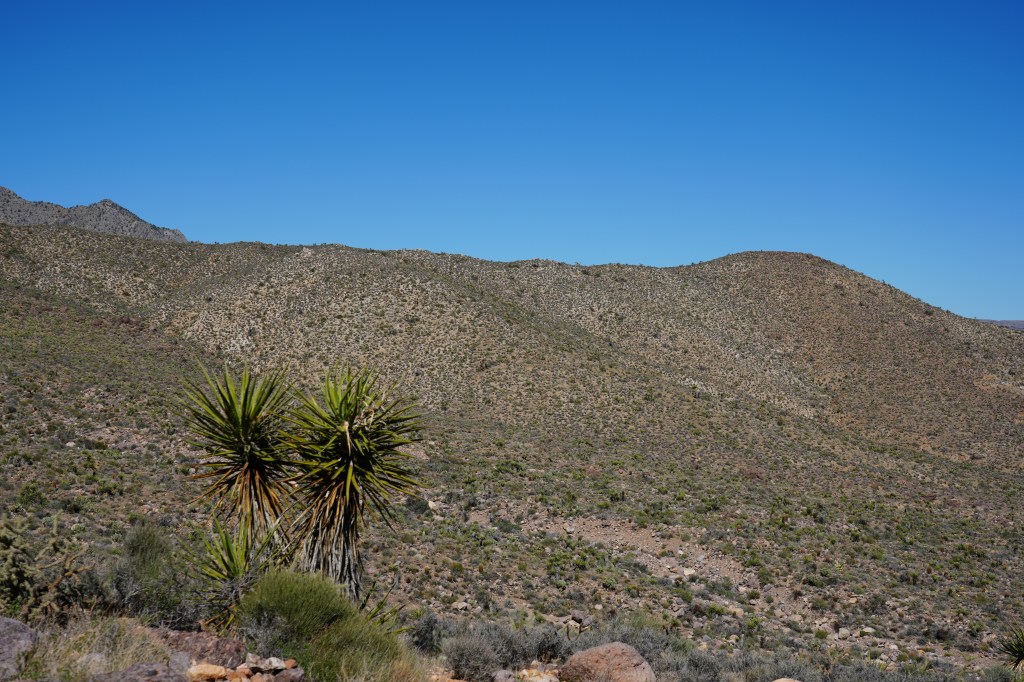
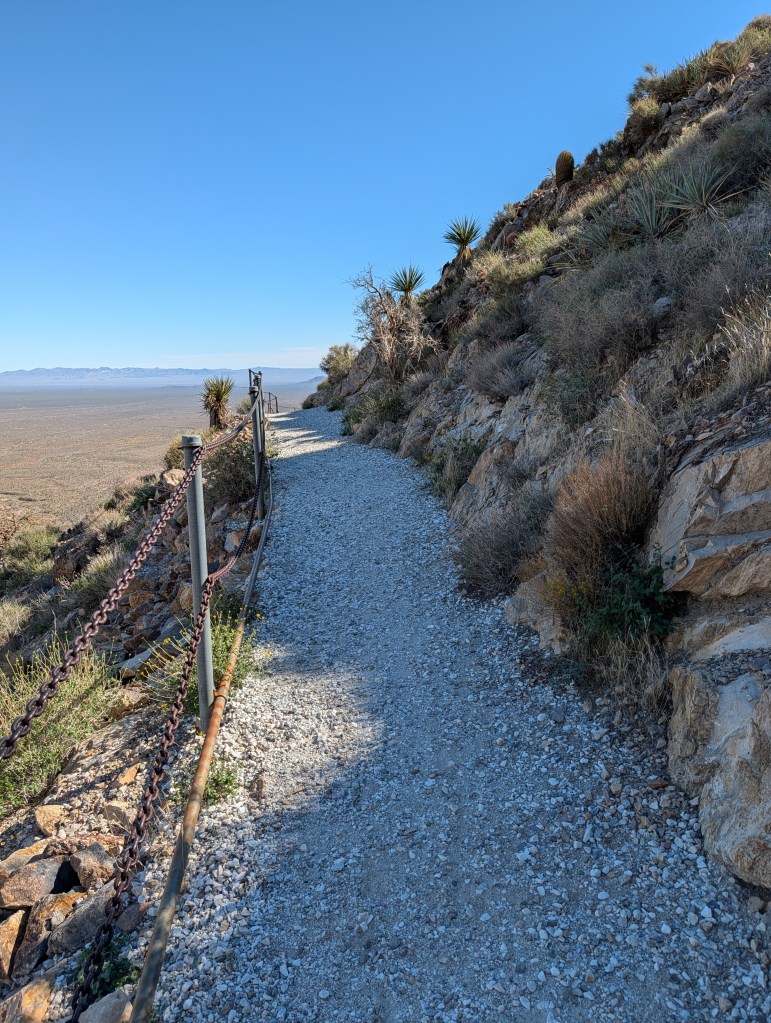
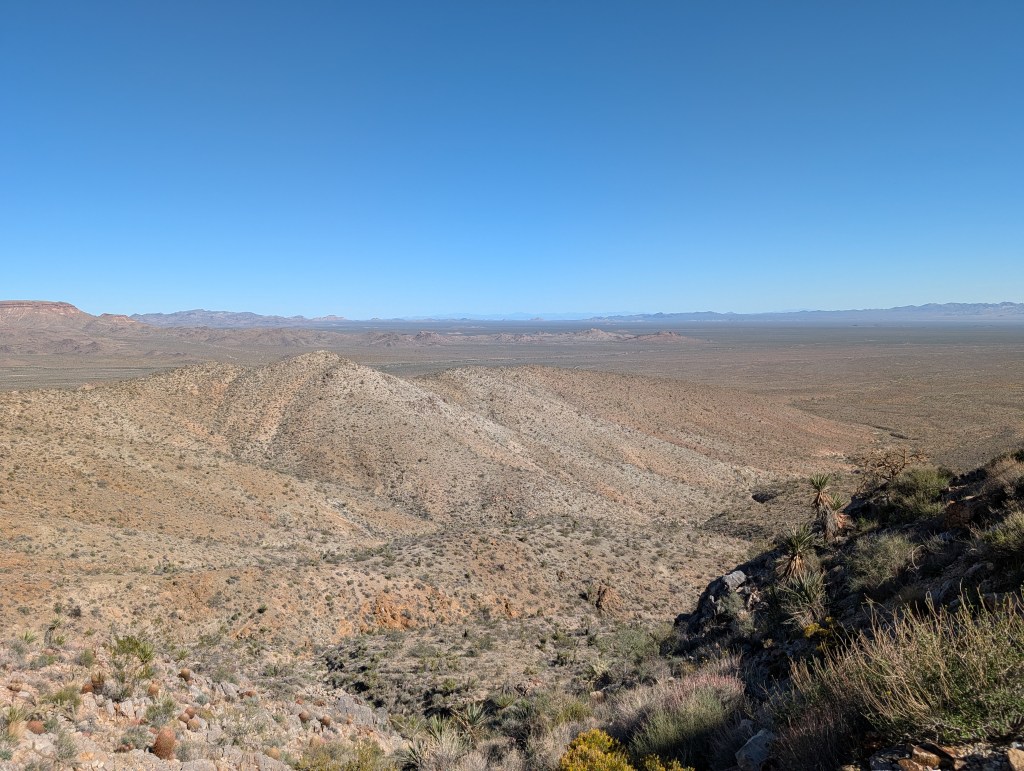
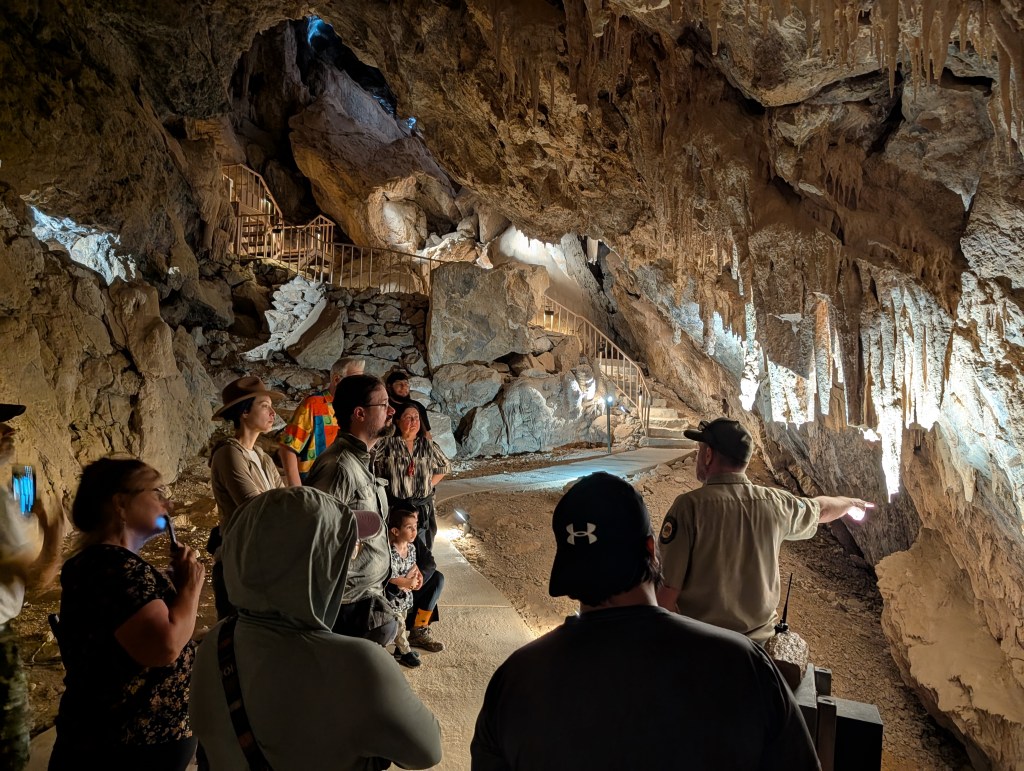
    There is a half-mile hike down a well maintained trail, mostly level, which has a bridge constructed across a deep wash. Incredible views of the desert. As you approach the bridge, you get your first view of the entry to the cavern. As it turns out there is one at the other end of the tour. This is actually a small cavern compared to the complex ones I’ve been to across the state. There are only a few rooms, and at the end, you can either exit there and walk back along the trail, or just trace your steps back to where we entered. It would be really hard to get lost in this cave. Unless the lights go out.

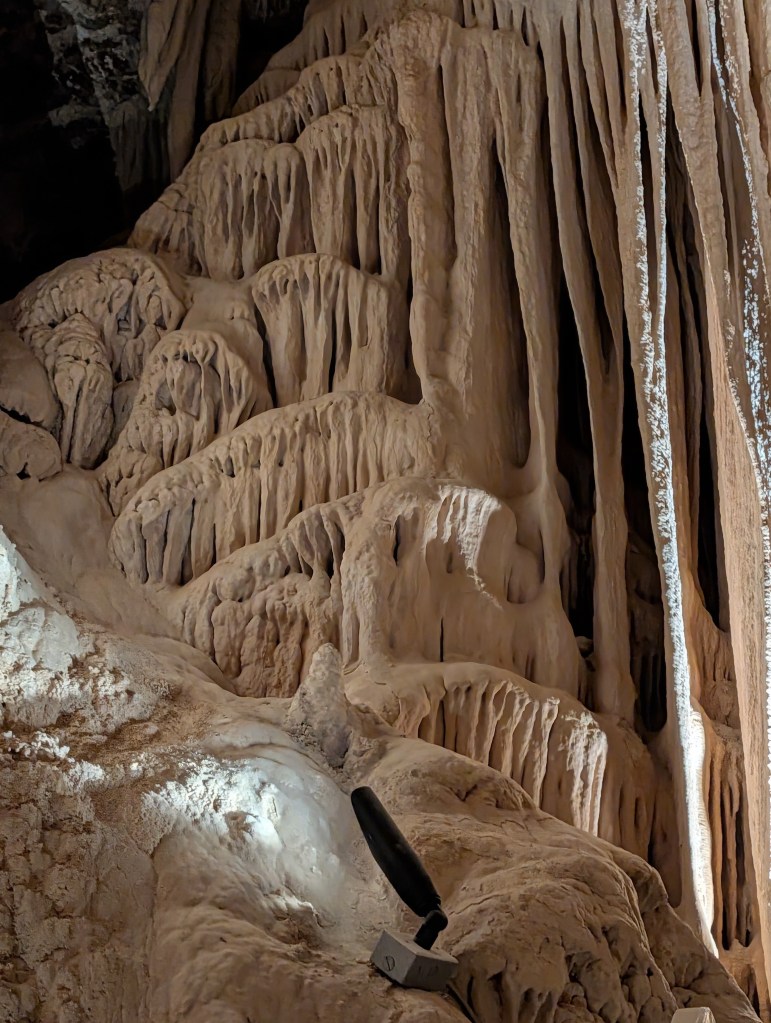
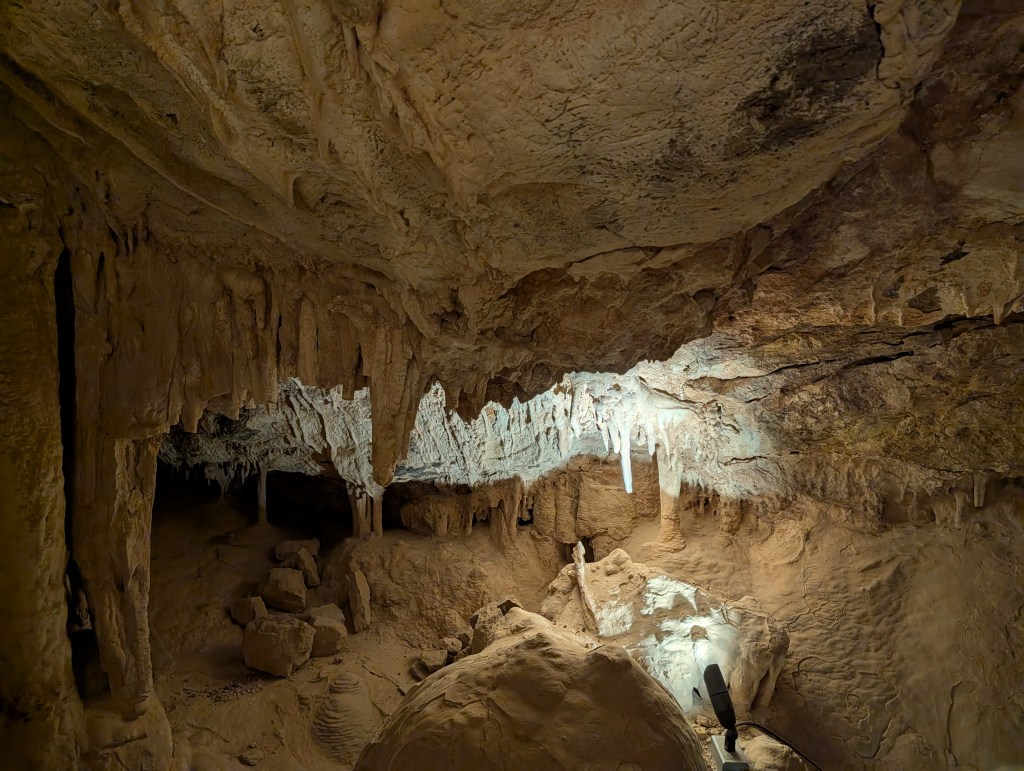
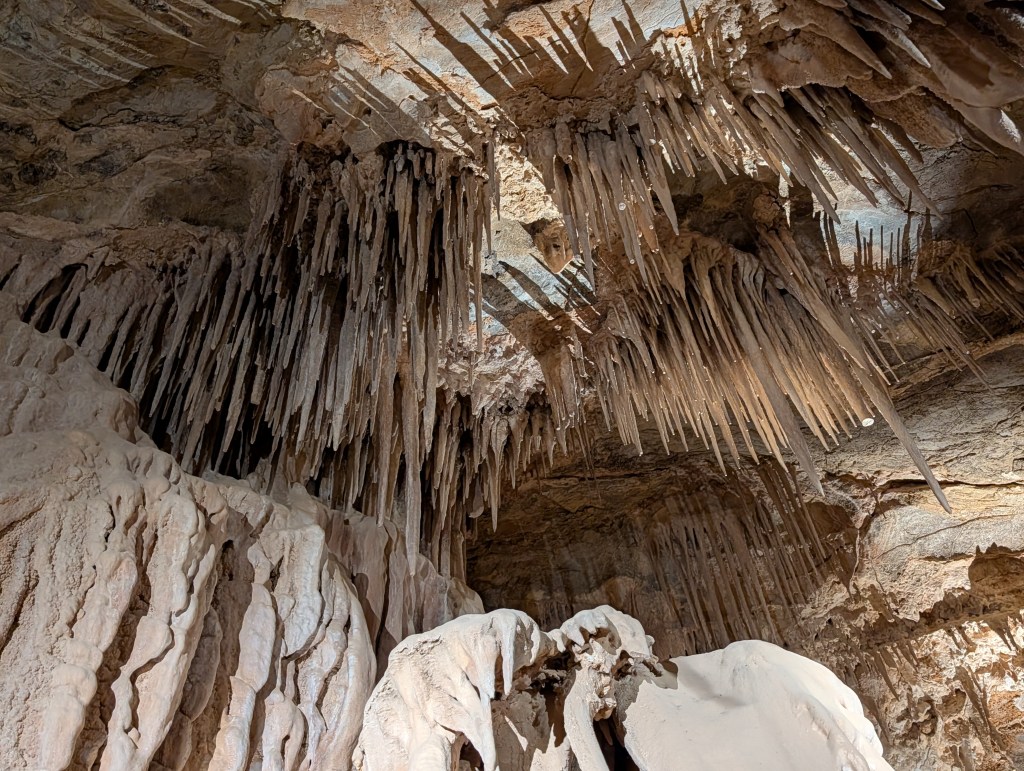
    The tour guide was a State Park employee, and knew the history, geology and then some, about the cave. The features were for the most part, the same as what you see in any cave. The big difference is that this one is really old – 20 million years, and also dry. It is in the latter stage of cave life, where nothing is growing, but things are starting to break – many of the stalactites are stubbed off. You don’t see that many in younger caves. The tour guide also discussed some microbiology topics which I had never heard about and which I’m now reading about. Mind blowing stuff.

    The other peculiar difference with this cave was that it was actually two different caves. The Park Service drilled a passage between the main cave, and a small, south facing one a few decades ago. The smaller had been used by humans in the past for storage, and was also frequented by ice age beasties. But since it had a south face, it was always warmer, and the temperature difference created a pressure differential, which created a breeze heading into the main cavern. This blew a lot of dust in, and also impacted the overall environment in the main cavern. So, the Park Service eventually installed steel doors at either end of the connection tunnel, Something else I’ve never seen before. 

    The other nice feature in this cave was the lighting – lots of it. The guide was constantly hitting switches along the way. I spent a lot of time figuring out how to capture video on the GoPro camera in low lighting, but did not really need it. 

    And now, for a bunch of photo’s

    The tour ended about 3:00PM, and the walk back to the visitor center was pretty quick. My Forest Gump brace and new hiking shoes, made a big difference in my stability on a trail. I started my drive back to Bakersfield about 3:30PM and made it back after 8PM. If you’ve ever traveled that route, there’s a long uphill and downhill stretch from Barstow to Bakersfield. Not so bad during the day, really tough in the dark when you are tired. Most of the traffic is tractor-trailers. I was really glad to make it back to the hotel. Totally exhausted. A warm Doubletree chocolate chip cookie, followed by a couple of beers helped. Dinner was pretty good too.

    If you are interested in driving to this obscure spot (there are other things to see in the middle of nowhere), here is good site to start with.

    Update: Oddly enough, the San Francisco Chronicle had an article on the Mitchell Caverns in the Sunday paper today (10/26). Maybe the author read this blog?

    I’ve got one more cavern on my California list – Crystal Cavern. It is closed until next summer. That’s a good thing.

    Moro Rock and Gross Bathrooms

    Moro Rock

    In case you are concerned about the title, I did not include any photos in this post of the bathrooms in the national park, nor will I spend much time describing them. Driving interstate highways, and visiting national parks during a government shutdown does make for some interesting and annoying challenges. I have traveled down I-5 and I-15 numerous times, and have regular pit stops along the way. Unfortunately, all the rest stops along the interstates are closed during shutdowns. That really changes everything for older folks who need to stop every 2-3 hours for bio breaks (I know, TMI). What’s definitely worse, are the bathrooms, mostly outhouses, in national parks. During one of the past shutdowns, I visited Joshua Tree. You could not get within 50 yards of any of the outhouses after a week. There was a dead zone of wildlife around each from the odor. Sequoia was just about at that point. But at least the park was open. And there are a lot of really big trees to hide behind – lots of privacy just off the road. 

    Jan and I visited Sequoia the first year we lived in the South Bay. I don’t remember too much about the trip – we stayed in Visalia, and spent one day in the park, just a quick in and out in the northern section. This time I entered through the south end, which seemed to be where most of the large groups of visitors were coming from. Free entry for all (I have one of the permanent senior passes). Without a park map, I had to rely on Google and Android Auto, which tends to not work too well when the internet fades in and out. But, there is just one main road running through the park, so it was not too tough figuring out how to get to Moro Rock. Why was I going there? Beats me. It just seemed like a nice hike, lots of steps, but nothing like the Manitou Incline. 

    I caught sight of this huge granite outcrop early on, and figured that had to be my destination. Getting there was fun – a seemingly endless number of sharp switchbacks, with lots of traffic. I eventually made it to the narrow side roads leading to the trail head parking lot, and found a close spot for the Subaru. And there was one of those toxic outhouses there. Safe for guys only. 

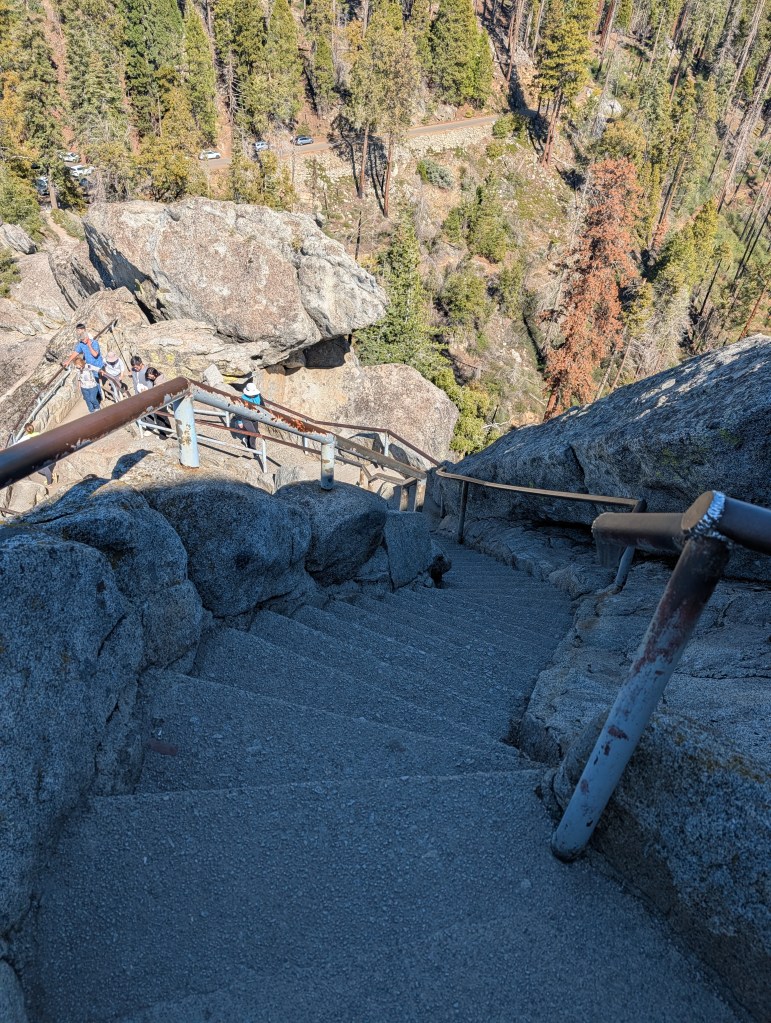
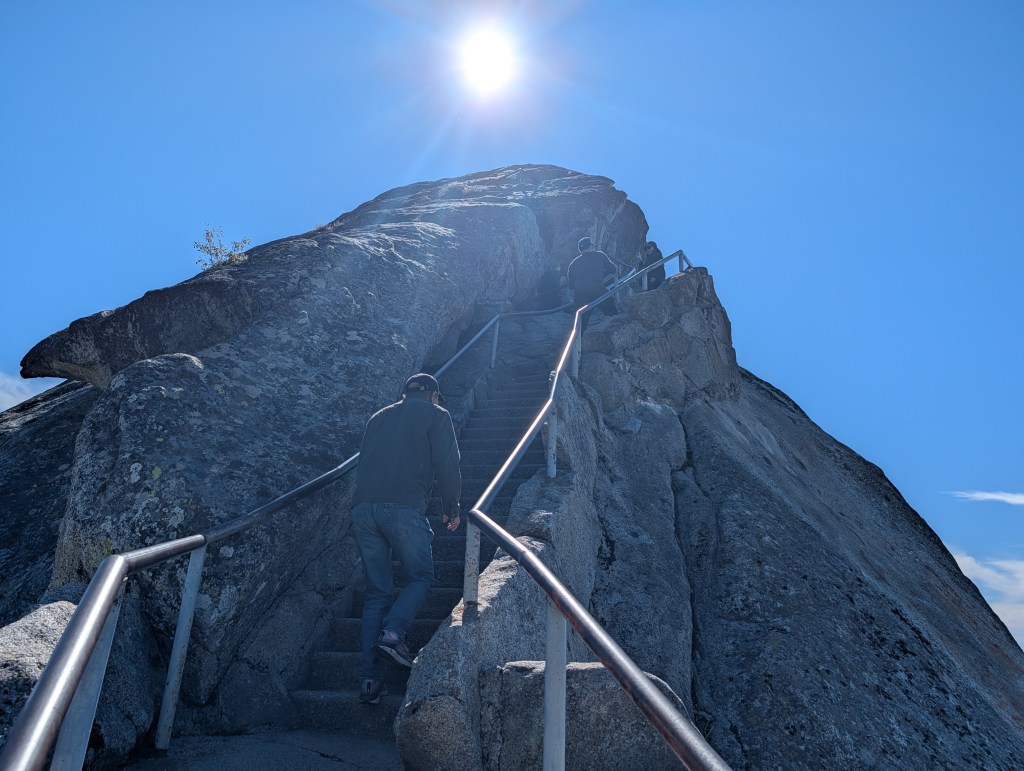
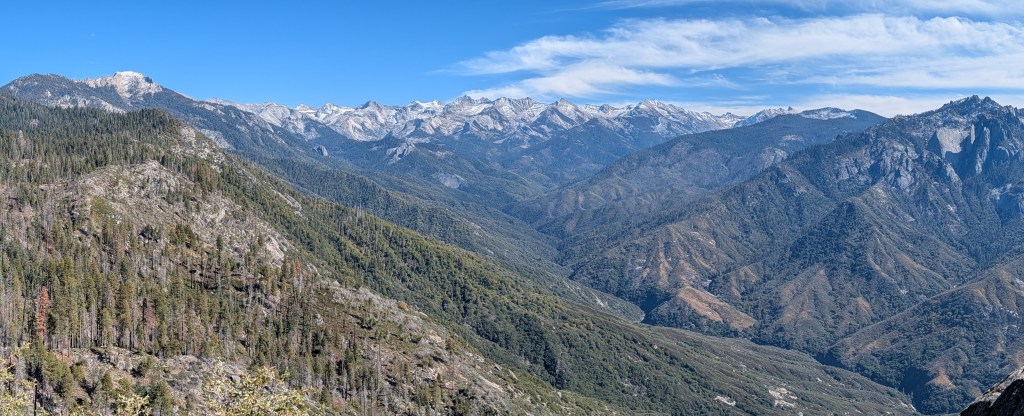
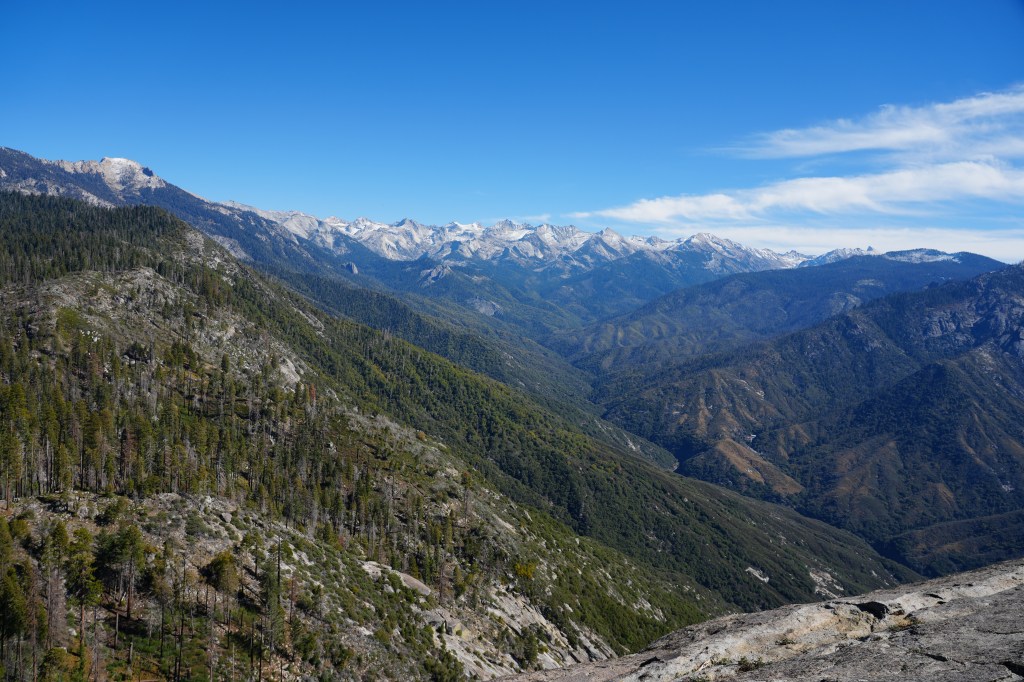
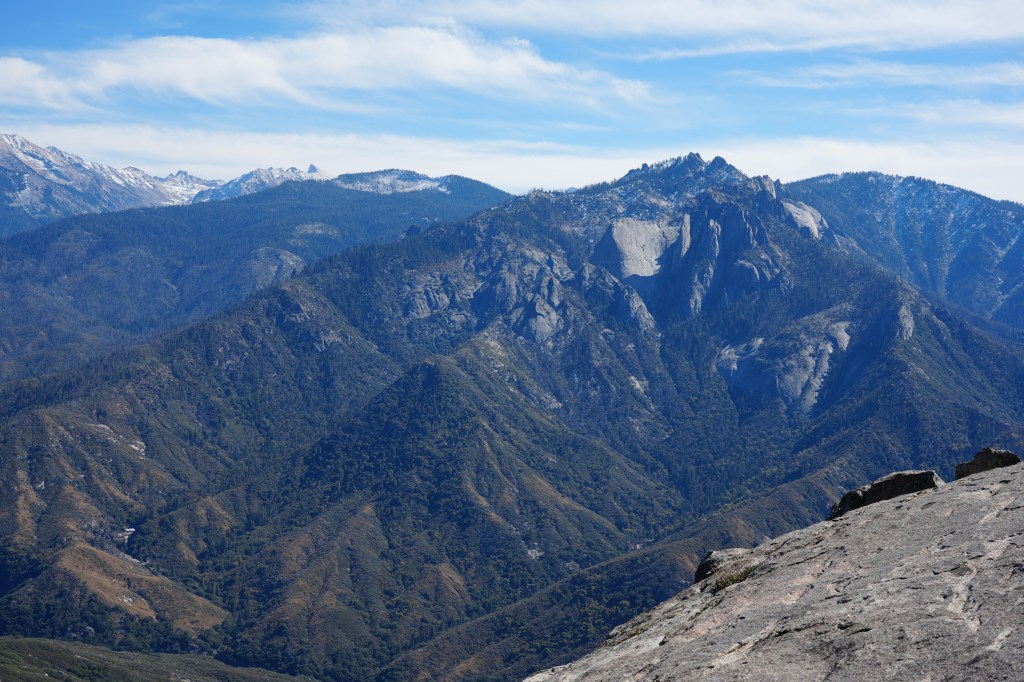
    Moro Rock is definitely one of the most interesting hikes I’ve been on. I do not know much about the history of the trail construction, but some genius engineer made a 5th-class rock climb into a relatively easy, family oriented hike to one of the most stunning overlooks I’ve been to. Sort of like Half-Dome with training wheels. There are 400 steps plus ramps, and railing going up 300’ to a narrow slice of granite, with absolutely incredible views of the surrounding peaks and lower valleys. It is a challenge for some since you are hiking at 6000’, and the exposure probably scares some folks off. But there were gobs of people, some with small children, making their way up to the top.

    After spending time at altitude in Colorado, this was a snap for me, especially with my Forest Gump brace and brand new hiking shoes. Having a stable base really helps. It was amazing on top – very narrow, with a line of people waiting to take selfies and group shots at the narrow end. What amazed me was the warning sign on the railings.

    Was this really necessary? They might have just posted a sign. “Don’t jump off the edge -you will die”. 

    Moro Rock

    I spent a lot of time taking in the view. It was stunning. I had a strange moment or two, but I’ll describe that in the journal. Overall, a great hike. The view from the top was beyond impressive.

    Moro Rock
    Moro Rock

    I was pretty much ready to head back home after making it down through the crowd heading up. I stopped at a few of the tourist spots, and shot a few pictures of the big trees. Definitely more of them here than in the state park I visited a few weeks ago. What was also amazing were the burned areas – there are huge sections of torched forest throughout the park. Most of the sequoias have burn marks at the base of the trees. The Forest Service and fire crews did an amazing job of saving these incredible trees. 

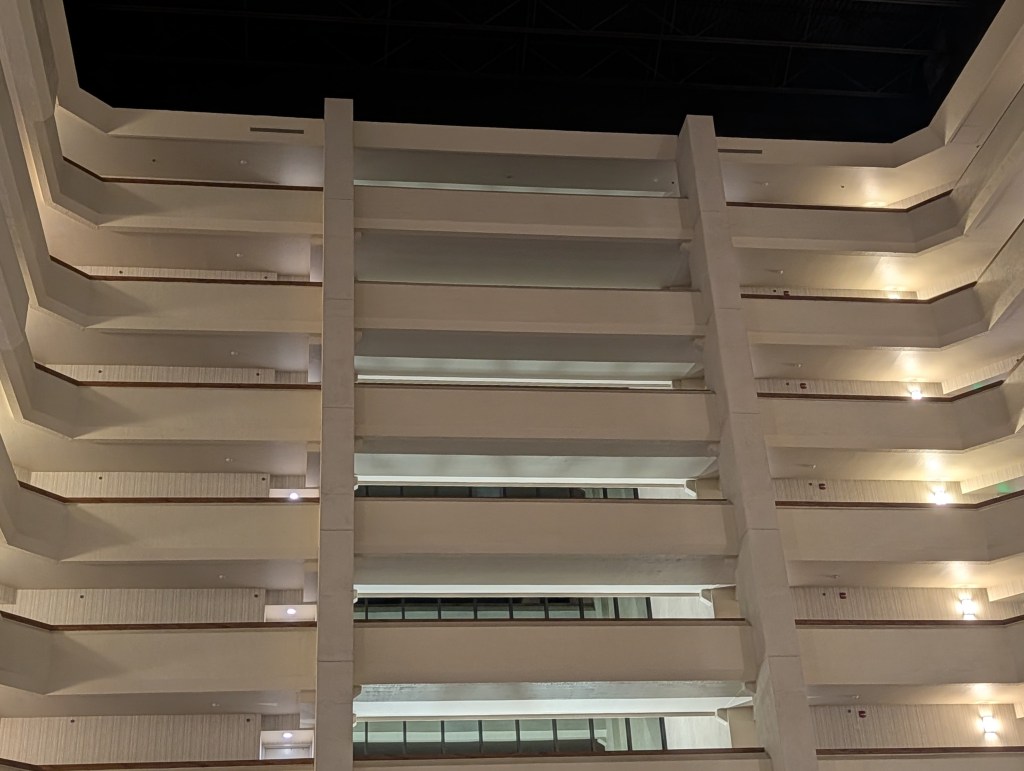
    I had booked a hotel in Fresno when I scheduled this trip, thinking that I would be too pooped from hiking to drive the 4 hours back home from Sequoia. Smart move on my part. I was doing OK and made it to the hotel by 5PM, but I was still tired from all the driving back and forth to the cave. And this turned out to be a really nice hotel. I did not have breakfast or lunch that day, other than a bag of M&M’s, so I made up for lost time at the bar. I do not usually include photo’s from a hotel, but this one (Doubletree Fresno) is pretty amazing.

    Overall, it turned into a pretty good trip. But this much driving in three days? Not going to do that again. I plan on taking it easy the next few weeks, before the Antarctica trip in November. I need to be in shape for fighting off the hordes of giant penguins. I wonder if there are any gnomes down there? I hope not.