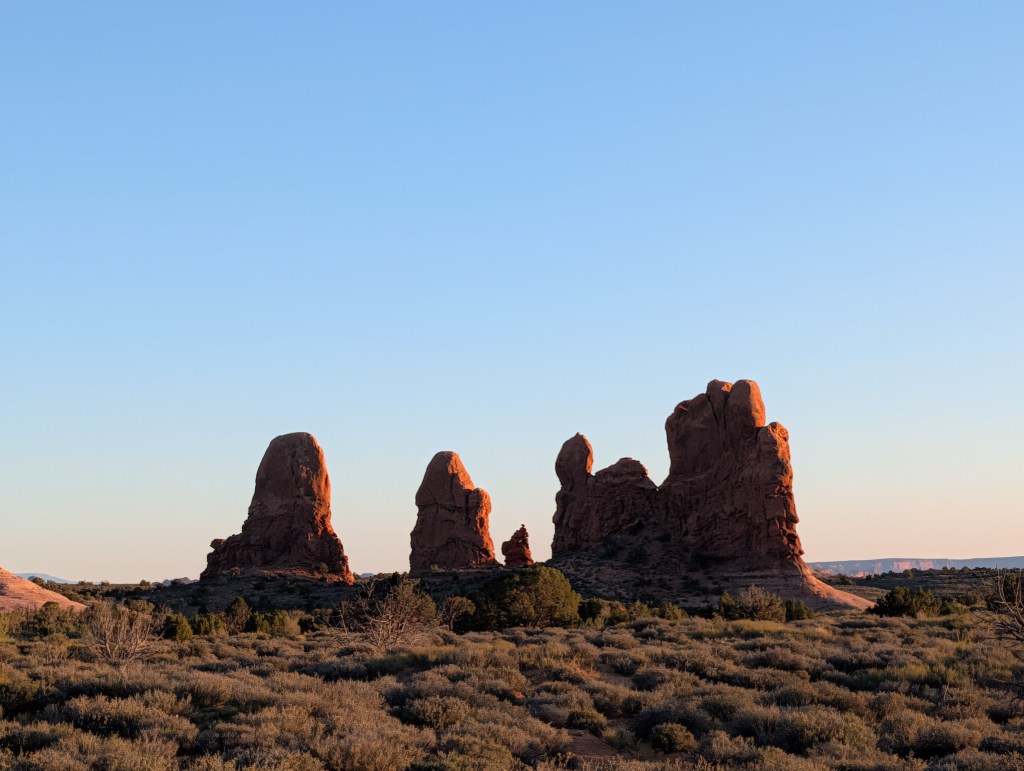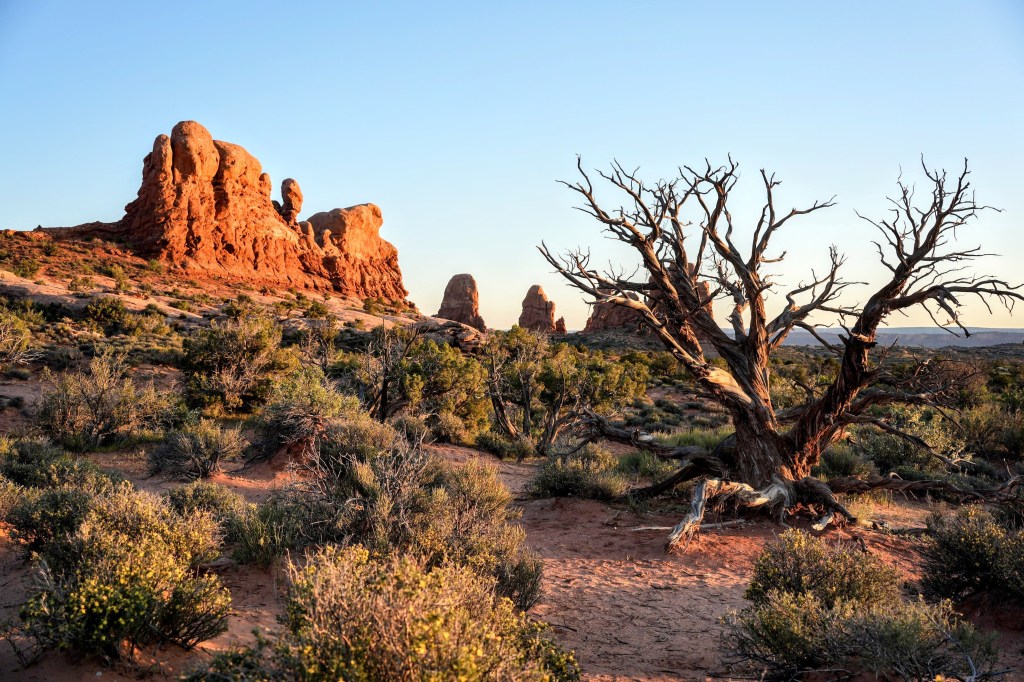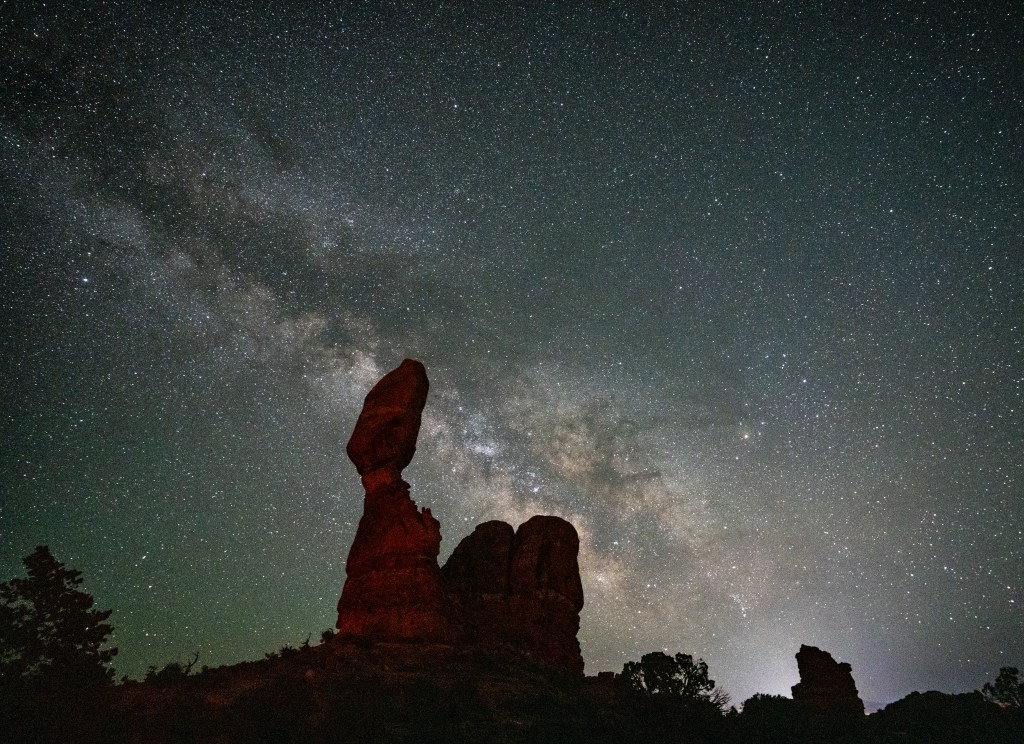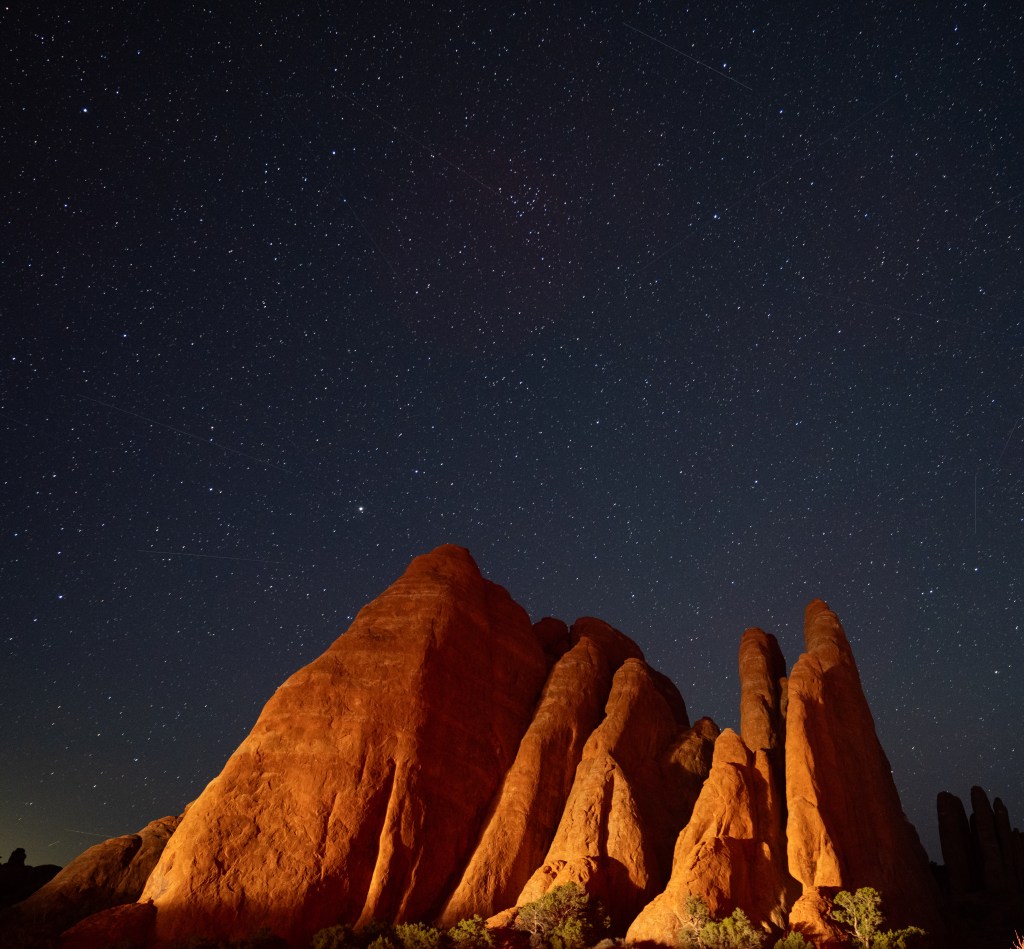
Category: Photography techniques

  • Moab & Arches National Park – First Impressions

    A vintage GMC truck with a playful face painted on the front, featuring large eyes and a big smiling mouth. The truck is rusted and weathered, parked in front of a wooden building with trees and a cloudy sky in the background.

    April 16th, 2026

    This has been a very different kind of trip for me so far – I usually have enough free time to work on blog posts, but I have been either driving, hiking, or doing something with cameras pretty much the entire time I’ve been here. And finding time to sleep has been a problem as well. So, here is an update on this trip before my afternoon nap, and heading out for about a 12 hours photo shoot this evening…..in the freezing cold.

    My flight out to Salt Lake City was uneventful – it’s only a 2 hour flight, and we got in early. For the first time in a very long time, I even arrived at the airport slightly less than 2 hours from departure. I’m living on the edge these days..

    This is the first time I’ve flown into Salt Lake City since, oh, maybe 1980 when I had a class in some long forgotten technology. I’ll bet the airport did not have jetways back then, and you boarded/departed the plane on stairs. Anyway, the airport is enormous now, and finding the rental car counters was a challenge. I eventually found Budget, got a little Chevy SUV-like thing, and headed south-east to Moab. What a beautiful drive! Once you get out of the main highway (US 15) past Provo, the landscape is incredible. It was a very pleasant drive on a mostly four-lane highway with lots of rest stops,  but it was very nice to finally motor into Moab around 5 o’clock. 

    As I mentioned in the last post, I have only been to Moab once before, in my undergraduate geology field camp back in 1972. Moab back then was a mining town – there was a huge uranium mine and processing plant, which closed in 1984, leaving a lot of tailings and waste to clean up. Back then, there was not much of a reason for tourists to flock here, so the town was pretty small. Now the main street is filled with brew pubs (yes, in Utah), restaurants, jeep tour offices and of course the usual tourist shops selling t-shirt/western type stuff. And a lot of hotels. And at least four ice cream and/or gelato shops. I kind of like the place – the town has nice vibes, sort of a larger version of Kanab Ut. And it is a 10 minute drive to the park entrance.

    A street view of a small town with shops, including a sign for Arches Trading Post. People walk along the sidewalk, and cars are parked nearby. The sky is bright with clouds and there are mountains in the background.

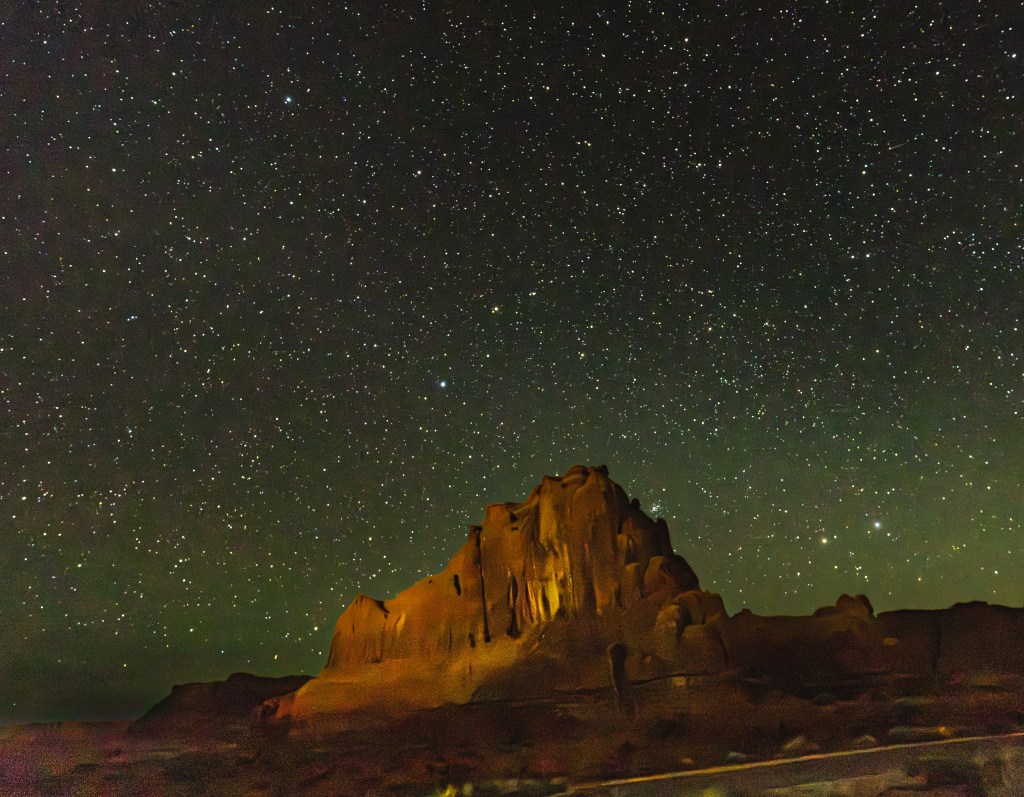
    After settling into a very nice room and grabbing some dinner at a nearby restaurant, I decided to take advantage of what was forecast to be a cloudless, but a bit windy, night. I might as well give it a try on my own. I did a Google search (of course) on the best location in the park for night photography, and chose one that sounded interesting (Balanced Rock), which was not too deep a drive into the park since I was pretty tired from the flight and drive. I loaded my gear and warm clothing into my sporty little Chevy, and headed off to the park a bit before sunset. 

    There were no lines getting into the park – it is open 24X7 but the entry booths are not staffed at night. Once you get past the entry point, the drive was one big “OMG” for me. The landscape is incredible – enormous walls of red sandstone, huge fins and rock towers. Absolutely spectacular. Very much different than Zion or Bryce. It was about a ten minute drive to the parking lot for the Balanced Rock – I pulled in, and did a quick walk-around to figure out where to set up once it got dark. And took a few pictures while it was light of course.

    There were a few other cars in the lot, also waiting for nightfall, and a steady stream of tourists stopping for selfies. Once the sun went down, few if any cars stopped by, but there was a steady stream of traffic heading towards the park exit, even at 10PM, there were still cars driving by. This was a problem for night photography – with a 20 second shutter speed, a passing car can ruin a shot. Or in some cases as I discovered, it actually helps to have the rocks “light painted”.

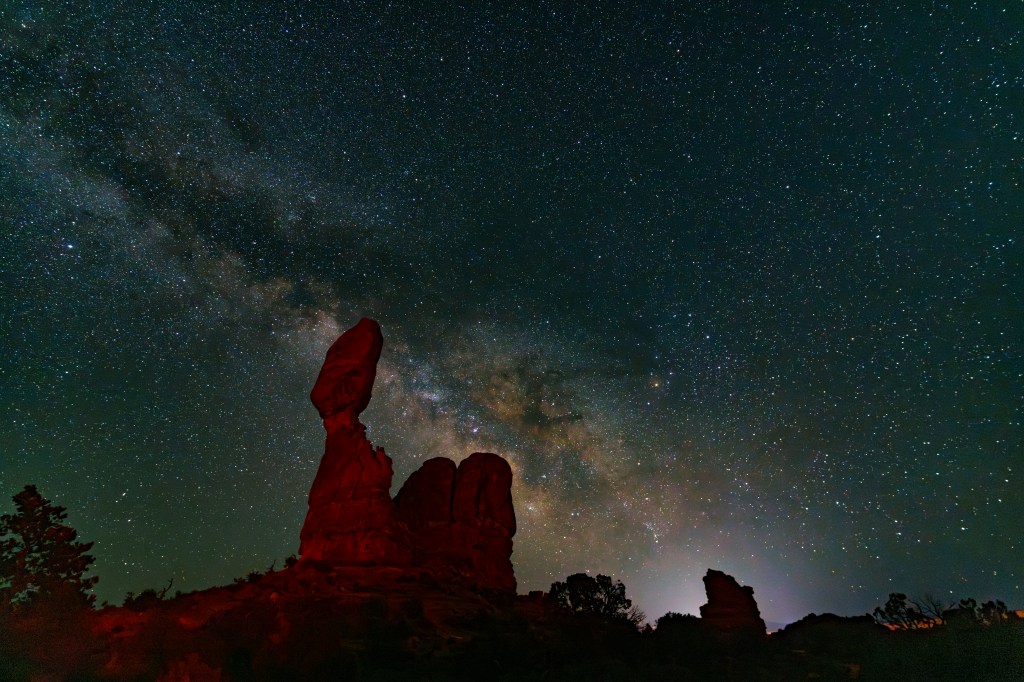
    A nighttime landscape featuring distinctive rock formations under a starry sky, with a visible meteor streaking across the scene.

    The other problem I had was with groups wandering around in the dark – it was incredibly dark so that you could not even see a foot in front of you. Every now and then, I would hear voices of people coming down the path and had to warn them before they walked into my tripod. There were also groups with flashlights, randomly pointing at the rock formations. Crazy town. 

    Eventually, I had my fill of this location, and decided to head back towards town. I made one more stop at another location requiring a short walk down a gravel path, and after that, headed back to the hotel. I was way too tired to look at any of the results, and just collapsed in bed.

    The next morning, I downloaded the photos on the SSD card to my laptop, and started doing some editing using Adobe Lightroom CC – I have been learning how to use this software, (Youtube videos), but I’m still a novice. Mostly what I did was changes to exposure, clarity, shadows – all basic editing, which is allowed in competition. I was surprisingly pleased at how some of the shots came out, given my lack of experience with astrophotography –  I’ve still got a lot to learn about camera settings and processing with Lightroom. That’s why I’m taking this course.

    And you can get a little crazy with the editing and get some very unnatural colors.

    A starry night sky over a unique rock formation, featuring a prominent balancing rock and lush vegetation silhouetted against the blue background.

    Thursday was another free day – the course officially started at 5:00PM when the group first met with the trip lead. Since I had most of the day free, I decided to check out the park in the daylight. Unfortunately, the weather was uncooperative for photography – heavy cloud cover and a lot of wind. But, I wanted to check out some of the famous arches and do a little hiking. The park was crowded, but not too bad – only a 15 minute wait to get through the entrance.

    Cars waiting in line at a park entrance with red rock formations in the background.

    First on my list was the best known feature of the park, the Delicate Arch. There are two trails to see this feature – one requires 3 miles of hiking on steep, rocky terrain, which gets you right up to the arch. The other is a mile hike up a steep, rocky trail which gets you to viewing area where you can see the hordes of people in the distance who hiked up the more difficult trail. I opted for the long range view, and I’m glad I did. 

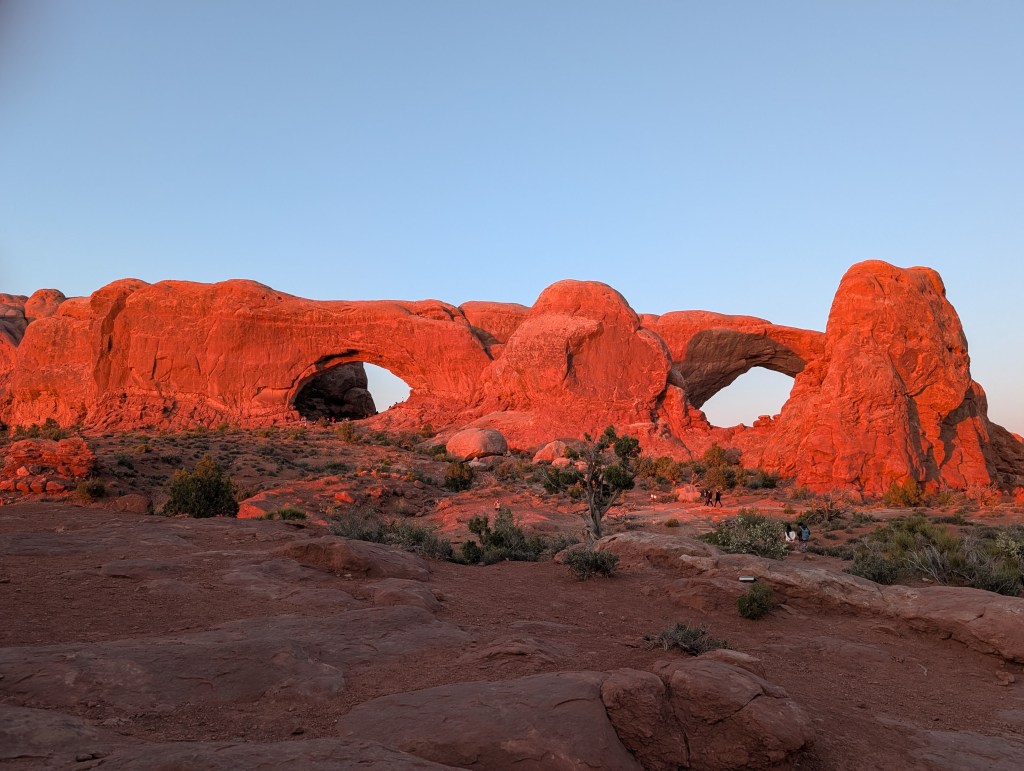
    Next on my list were the Windows, two large arches close to another well known feature, the Double Arch. The lighting was extremely flat by then, but I hiked up some of the trials for the fun of it – I’ve got a few more free days, so I’ll hopefully get a chance to photograph these in better conditions. 

    I met up with the rest of the group later that afternoon – a good mix of folks, mostly from the Denver area, but a few from other parts of the country. There was also a mix of experience with the group – some had been on this same trip before with the same lead, and most everyone had prior experience with astrophotography. I also had a bad case of gear envy – many of had higher end cameras and lenses, a few with the top end Sony cameras. It also became apparent on how this was different from all my other trips – this was all about the process and technical details of astrophotography. The trip lead is an expert in this field, and the focus of the course is all about the camera gear and understanding the fine details of tuning it for capturing low light from the stars. What was missing from the initial workshop session and first outing, was any discussion of the park and region, unlike Road Scholars and National Geographic trips. No culture, no geology, no flora or fauna – just cameras and how to shoot the stars. I doubt if I will ever focus much on star photography after this trip – this was just one of those topics I’m interested in enough to take a course like this, and I will be doing more night photography for the Northern Light trip. But I cannot see myself investing in the specialized gear and software for stacking photos of the Milk Way or creating those cool spiral shots of star tracking. But that could change I guess.

    Our first workshop session was enlightening though – I learned a lot about the fancy camera I have, and the basics of star photography. We then headed out for our first session at 11PM – the weather was not exactly conducive for photography – cloud cover, cold, very windy, but the lead wanted to at least show us how to “tune” the camera settings, and that needed to be done out in the wild. The bare basics were how to set your focus correctly – that’s not as easy as it sounds. I had fortunately lucked out in getting the settings right on my own, but now understood more on how to balance between the aperture, shutter speed and ISO to get the sharpest photos. And for focusing the camera….well, you don’t just set your focus to infinity. You’ll wind up getting blurry stars. Why? The stars are beyond infinity! You actually just have to pick a star, not a planet, and manually focus on it until it is small and clear, and then tape the focus ring on the lens. You’re all set at that point.

    Enough technical details for now. We headed out in five cars – I decided to drive on my own in case I was too tired and wanted to head back early. It really did not matter – it was too windy and cold to do anything other than set the focus under the trip leads supervision, and then we headed back to the hotel. The clouds were rolling in again anyway, so there was no sense in staying any later. The spot we wound up in for our calibration exercise was an issue for me – we had to hike down a rocky trail in the dark – the trail would not have been a problem for me in the daylight, with my hiking stick, but a bit frightening with only my headlamp to light the path. I wound up using my tripod as a hiking stick on the way back. No damage done, and I did get to sleep by 1:30AM. 

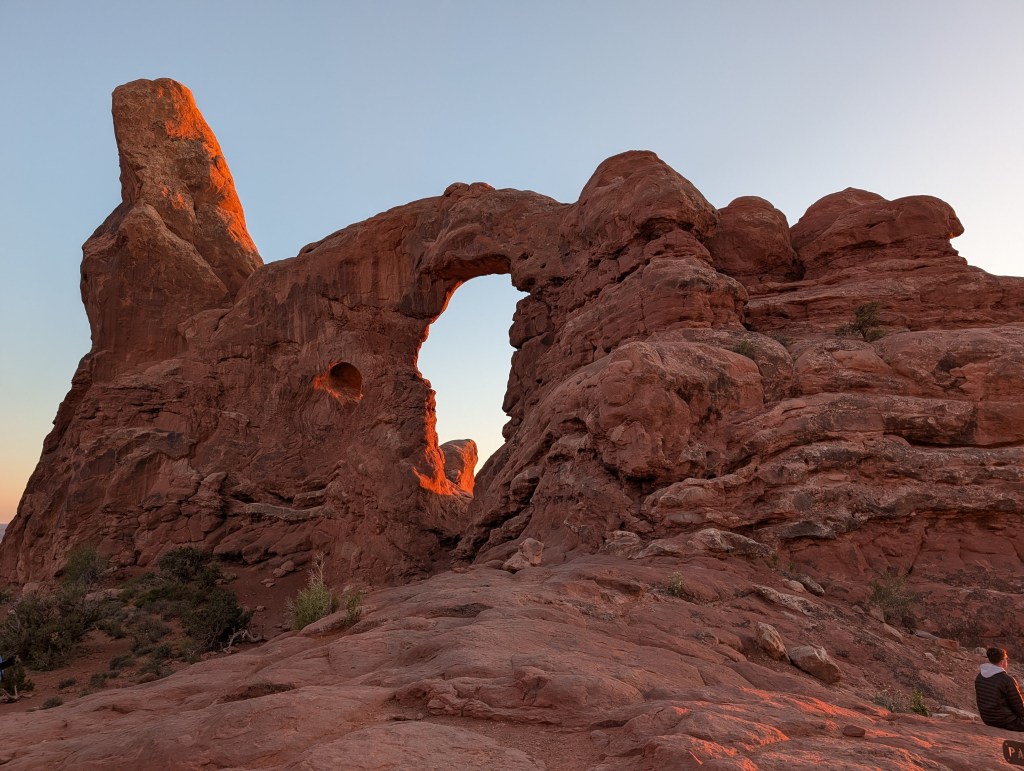
    I did not get much in the way of photos from this second day (first of the trip) – I’ve included a few of the Windows arches (more stairs to climb!), and some other odds and ends including Delicate Arch, taken from a distance. This evening (Friday) we are heading out for sunset, and then multiple stops for Milky Way photography, and should be back by dawn. The skies will be clear, but the temperatures will be down in the teens. I did not pack for winter, and had to buy some thermal underwear. I’ll be spending a lot of time in the car with the heater on.

    One last strange photo – never seen an outhouse with one of these before.

    A stainless steel squat toilet in a restroom, featuring a round opening in the center and textured foot positions on either side.

    On that note….Peace.

  • The First and Only Day – Baja Part III

    A sandy path leading to the ocean with a pier in the distance under a clear blue sky.

    February 24th, 2026

    It was not easy getting up early on Tuesday – I was still tired from my late night E/R experience on Saturday/Sunday, and had to get up at Oh-Dark-Thirty on Monday for the trip to Ensenada, so a 5:45 AM wake-up was tough. But, I managed to stumble off for breakfast at 6:15, and had everything ready to go for loading up the vans for the short drive to the dock. 

    The “visitor center” for the whale watch tours consisted of an office for buying tickets (which we did not have to do), a small cafe and gift shop, and a room where you get your life vest. And a few port-a-potties back in the parking lot. After getting the vests, we all headed out on the long dock to load on to the boats (Panga’s) – the loading dock was kind of fun since it floats and rocks, so boarding the boats can be a challenge. The first boat out only had four passengers while mine had 7. Not crowded, but I’d rather have been in the first boat. 

    My plan for  this first trip was to get the lay of the land so to speak for photography.  I had three cameras plus my phone, and I wanted to experiment and find out what worked best for the remaining 5 trips out to the lagoon. After all, I’ve never photographed whales from 6 inches away before. 

    This was absolutely a perfect day – just warm enough, no wind, and the water was really calm. We saw lots of whales as soon as we headed out. The first boat was far ahead, and already had a bunch of whales surrounding them, so we went over to share. No whale hogging allowed on this trip. That was not a problem as it turned out.

    A group of people in life jackets interacting with a gray whale next to a small boat in calm waters.

    It was an amazing experience. We had 3 or 4 whales coming right up to the side of the boat, rolling over like Golden Retrievers. Yes, I did rub one of them – really soft skin. And no, I did not kiss them. Other people in our group did that. At one point, we had two adults and one baby on one side of the boat, and one swam under, scraping along the bottom of our boat. It was impossible to get a full photograph of the whales – just whatever portion of their body that was sticking up next to the boat. They move around quickly, so it is pure luck on what you capture with the camera. 

    I started out photographing with the Sony when the whales were over by the other boat, but quickly switched to the GoPro when three or four whales approached our boat. I wish that I had just used my phone for the close up. I totally gave up on the other underwater camera I had brought along. One other challenge was the other passengers in the boat – I wound up with a lot of heads, arms and other body parts in my photo’s – not much you can do about that. Not everyone is focused on photographing the whales. So, here are a few of the still shots I made that morning – mostly close-ups of the head and blow holes.

    I did luck out with some of the GoPro videos – this one is the best. I managed to get most of a whale, including the eye. I have a few more clips I’ll put on the next post.

    All good things come to an end unfortunately – the boat drivers have to be back after 2 hours, so we left our friendly whales and headed back to the visitor center. I was pleased – I figured out what I would do in the afternoon session – just use my phone and the GoPro, and maybe switch out the wide angle for the regular lens on the GoPro.  Once we got to the dock, I managed to get out of the boat without falling in the water, and made it back to the center to turn in my vest.

    A wooden pier extends over calm water, leading away from a sandy shore. Several people wearing orange life jackets walk along the pier, with a seagull perched nearby. In the background, there are buildings and distant hills under a clear blue sky.

    On the drive back, we noticed an Osprey having lunch, sitting on a sign. These birds are all over the place – they build huge nests on top of the port-a-potties, or any other structure convenient for them. This turned into a great photo-op for me with the Sony camera

    An osprey perched on a wooden sign that reads 'No Pase Zona de Restauracion', with a fish in its talons in a natural landscape.

    Once back at the camp, we all headed over for lunch, and had about an hour afterwards to rest before we went back to the visitor center for our next outing. I went back to my cabin and started checking out the battery levels in my cameras, when all of a sudden, the world started spinning around, and my heart was pounding. Crap – this was just like what happened on Saturday night. Once again, I tried to just calm down, but my BPM was way over 100, and I staggered every time I stood up. I realized that going out on the next whale trip was not going to happen, and that maybe I should get some help. Calling 911 was not going to work this time.  Fortunately, the door to my cabin was open, and I must have looked like I needed help – I soon had three staff members asking what was wrong, and one of them rushed over with a blood pressure cuff. Way high, not too surprising. The van drivers were hanging around waiting to see what I was going to do, so I told them I’d stay behind, and the group headed off for the boats.

    One of the staff members came back with a home made Gatorade mix, since I was probably still dehydrated from the previous days, and they set me up in a shady spot where I could rest. I was not sure what to do – I was scheduled to take the van ride back to San Diego on Friday, and maybe switching to the plane would be a smarter move. Or maybe I could switch to Thursday instead. I still wanted to get a few more cracks at photographing the whales. I passed this request on to the staff, to check with Keith (the owner). Needless to say, I was really depressed, stressed and a bit panicked now.

    I rested for a while, and then walked up the hill to the dining hut for a refill of the Gatorade mix, and to have someone to talk to. Keith was already there, waiting for me. He first said that there was no room on any of the flights out. And then he lowered the boom – he was very concerned about my condition and put it bluntly to me. If anything serious happens, I will die there. There are minimal medical services in Guerrero Negro, and there is nothing close by that can handle heart related issues. He told me I should get back to the US ASAP – he could get a car to drive me back later in the day, or early tomorrow. It was my choice, but that was his recommendation.

    I gave it some thought for a few minutes – part of me REALLY wanted to stay. The intelligent voice, and probably my wife’s as well, was saying…”Idiot, get your ass back to the states!!!” Intelligence won the argument. It was not just the risk, but also the impact I could have on everyone else. What would happen if I had one of these incidents while we were out in the lagoon? I guess they could just push me overboard. At any rate, I told Keith I’d leave and he went off to make the arrangements. I finished another glass of the homemade gatorade, and pondered my fate. Lots of bad words. This was a really bad day to have given up drinking alcoholic beverages. 

    After a while, the dizziness was gone, and my BPM was down to something more reasonable, so I decided to take a long walk along the beach, and find someplace to sit and relax. And curse and cry in privacy  By the time I got back to my cabin, Keith had everything set – I would leave early the next day – the driver would arrive at 5:30 AM. Another very early morning. The driver did not speak English, but we would switch cars close to the border, with a driver who could get across the border, and also spoke English. I could hardly wait. I enjoy adventures, but this was one I could have lived without.

    So, I had a nice dinner with the group, enjoyed watching them play some very strange game which involved eating poisoned jelly beans (not really, but it was peculiar and funny), and wandered back to my hut. Such a shame – I was really enjoying this trip – what a fun group of people, and incredible staff.

    My favorite all-round photo from the trip (not really):

    Two portable toilets and storage boxes on a sandy beach with a figure standing in the distance against a clear blue sky.

    One more post after this…I promise. I like to draw out the story.

    If you are interested in this type of adventure, here is a link for the Baja Jones whale camp: wwww.graywhalewatching.com
    I really enjoyed my brief stay – it seems a bit primitive, but the staff is wonderful, the cabins are comfortable, and the trip down to Guerrero Negro may seem complicated, but it turned out to be a fun experience. And seeing (and touching) these beautiful animals so close, was absolutely incredible. I will hopefully be able to go again.

    And if you are REALLY adventurous and want to drive to Laguna Ojo de Libre and camp, you can rent one of the pads, and just sign up for one of the whale watch tours: https://www.campendium.com/laguna-ojo-de-liebre-campground